After servicing homes across Deltona and Volusia County, we've had this conversation more times than we can count. A homeowner calls about a new AC system. Heating comes up. They wave it off. "This is Florida." We understand the instinct. We also know what happens in the homes that act on it.
Here's what years of working in this market has taught us: the heating question in Deltona isn't really about surviving winter. It's about what happens to a home — and the air inside it — when the system managing temperature and humidity goes partially or completely offline for months at a time. Deltona's winters are mild. They are not static. Cold snaps hit. Humidity swings. Indoor temperatures drop into ranges that a cooling-only system can't address. And a system that isn't running isn't dehumidifying.
That last point is the one most homeowners don't see coming. In a climate where moisture control is the difference between a healthy home and a mold condition, a system that sits idle through winter isn't just uncomfortable on cold mornings. It's a system that has stopped doing one of its most important jobs — maintaining proper airflow and humidity balance, something top HVAC system installation near Deltona FL helps homeowners achieve for healthier indoor air and year-round comfort.
This page gives Deltona homeowners the honest answer on heating — not the version written for northern winters, but the assessment that only comes from years of walking through real homes in this market and understanding what Central Florida's climate actually demands year-round.
TL;DR Quick Answers
Top HVAC System Installation Near Deltona FL
The best HVAC installation near Deltona FL starts with a licensed, permitted contractor who performs a Manual J load calculation before recommending any equipment. For most Deltona homes, a variable-speed heat pump is the strongest system choice — it handles both heating and cooling, manages humidity more effectively than single-stage equipment, and performs efficiently in Deltona's mild winters without relying on backup heat strips. Plan for $5,000 to $12,000 or more depending on home size, duct condition, and equipment tier. What to confirm before signing:
Florida state license verified through myfloridalicense.com
Permit pulled through Volusia County Building and Zoning
Manual J load calculation included in the scope of work
Full duct assessment — leakage testing and insulation verification
Service twice per year — early spring and early fall
Improper installation increases household energy use by up to 30% (NIST) and duct leakage alone causes an average 37% loss in cooling efficiency (DOE). In Deltona's climate, where systems run close to year-round, installation quality determines comfort, humidity control, and operating costs for the life of the system. Qualifying high-efficiency systems may be eligible for federal tax credits up to 30% through ENERGY STAR.
Top Takeaways
The installation determines the outcome — not the equipment. A mid-range system installed correctly outperforms premium equipment installed carelessly. In Deltona's climate, installation quality affects three things from day one:
Comfort
Humidity control
Monthly operating costs
Improper installation carries a measurable, permanent cost. Two findings that apply directly to Deltona homes:
NIST: Improper installation increases household energy use by up to 30%
DOE: Duct leakage and inadequate insulation alone cause an average 37% loss in cooling efficiency
These penalties don't self-correct — they run on every utility bill for the life of the system
Heating in Deltona is a moisture management decision — not just a cold weather one. A system without functioning heat goes partially offline in winter. In a climate where mold conditions are essentially always present, that means:
Unchecked humidity
Condensation developing in unseen spaces
Air quality problems that show up months after they start
Four steps matter more than any equipment specification:
Verify the contractor's license through Florida DBPR
Confirm the permit through Volusia County
Ask for the Manual J load calculation
Understand the duct plan before work begins
Deltona's Winters Are Mild — But They Are Not Forgiving
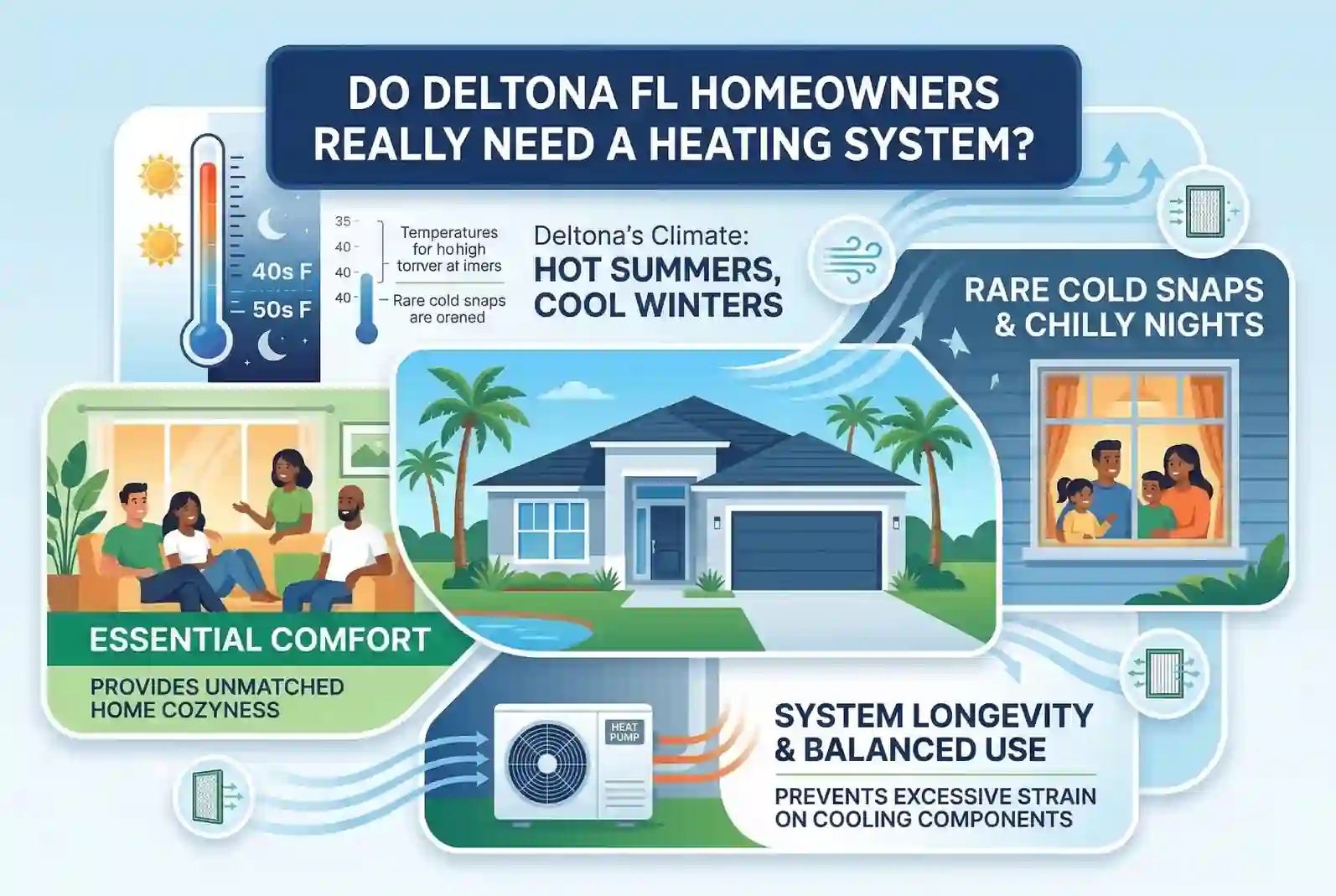
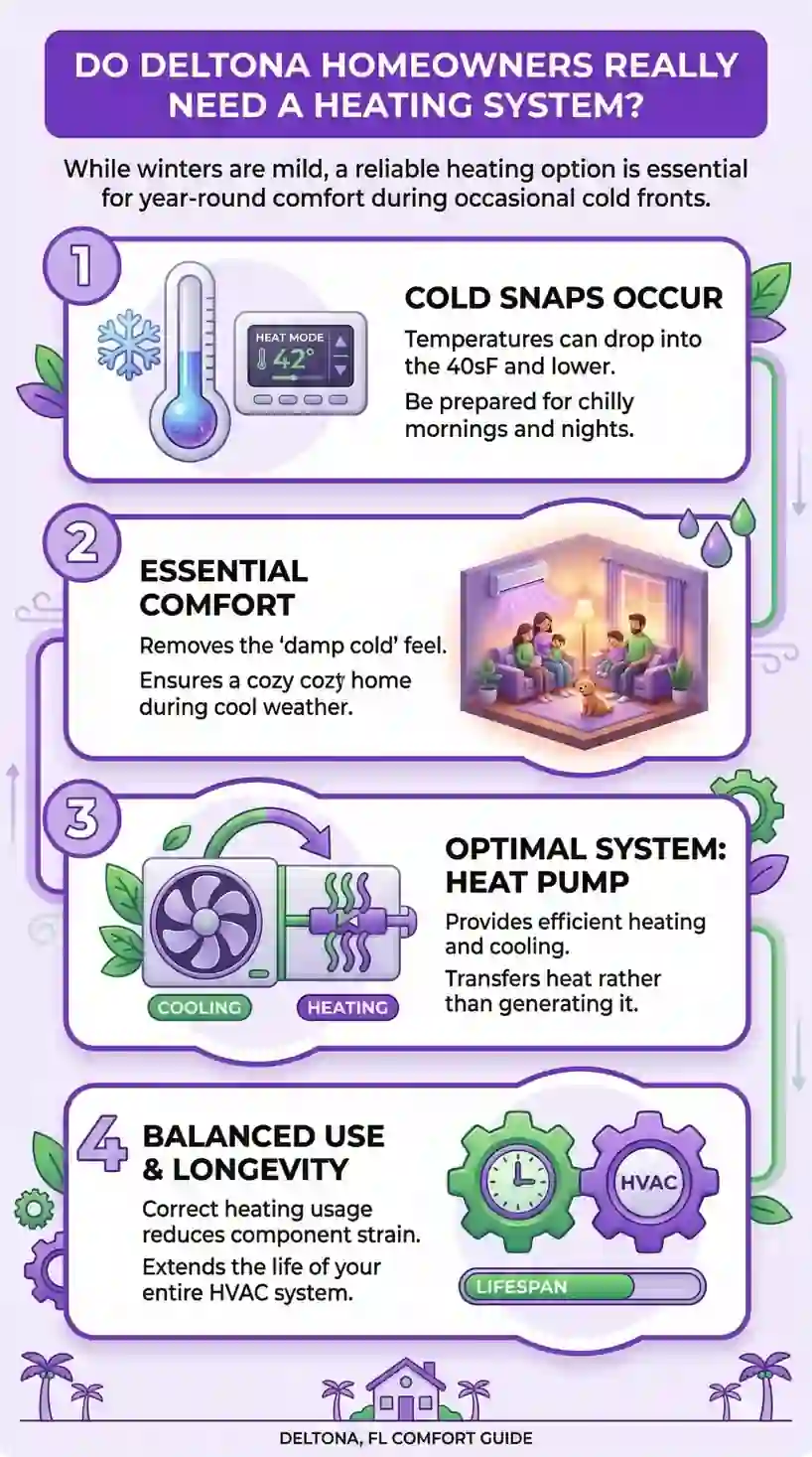
Central Florida averages overnight lows in the 40s between December and February. That's not a Minnesota winter. It's also not nothing. What we see in Deltona homes during cold snaps tells a consistent story: heat strips failing because they haven't run in 18 months, thermostats unable to reach setpoint on 38-degree mornings, and homeowners discovering mid-January that their system's heating component hasn't worked in years — because they never needed it until that week.
A heating system in Deltona isn't emergency infrastructure for a brutal winter. It's standby capability that needs to work when called on — and systems that sit unused for months require maintenance to perform reliably when conditions change, which is why regular service from a professional HVAC system installation is important.
A System Without Heat Is a System Running Incomplete
Most Deltona homes are served by heat pumps or split systems with electric heat strips. Both provide heating and cooling from a single integrated unit. When the heating component fails or is absent entirely:
The system cannot respond to temperature drops below the cooling threshold
Humidity management gaps develop during cooler months when the system runs less frequently
Indoor air quality suffers as the system's ability to circulate and filter air is reduced
Occupants compensate with space heaters — introducing fire risk and driving up energy costs
In our experience servicing homes throughout Volusia County, the households that deferred heating maintenance or skipped heating capability entirely paid for that decision eventually — either in an emergency repair call on the coldest night of the year or in air quality conditions that developed quietly over a mild but damp winter.
Heat Pumps Are the Practical Answer for Deltona's Climate
For Deltona homeowners evaluating heating options, a high-efficiency heat pump resolves the question cleanly. Here's why heat pumps make sense specifically in this market:
They provide both heating and cooling from a single system — no separate furnace required
They operate efficiently in mild climates where temperatures rarely drop below freezing
Variable-speed heat pumps manage humidity during transitional seasons — not just temperature
Qualifying systems are eligible for federal tax credits of up to 30% of project costs through ENERGY STAR's efficiency incentive program
A gas furnace is rarely the right answer for a Deltona home. The heating load simply doesn't justify the infrastructure. A properly sized heat pump handles everything Central Florida's winters produce — and does it at a fraction of the operating cost of resistance heat.
The Humidity Argument for Year-Round HVAC Operation
This is the part of the heating conversation that most contractors skip. In Deltona's climate, an HVAC system that runs year-round isn't just providing comfort on cold mornings. It actively manages indoor humidity through every season — including the ones where outdoor temperatures are mild enough to tempt homeowners into opening windows and turning the system off entirely.
What we observe in homes that go extended periods without active HVAC operation:
Indoor relative humidity climbs toward and above the 60% threshold the EPA identifies as the primary driver of mold growth
Condensation develops on cooler surfaces — windows, duct exteriors, pipe runs
Mold conditions establish quietly in spaces the homeowner isn't monitoring — inside air handlers, along duct seams, behind walls adjacent to return vents
A system that runs year-round — heating in winter, cooling and dehumidifying through the rest — keeps indoor conditions stable across every season. That stability is what protects a Deltona home's air quality, its building materials, and the health of the people living in it.
What Deltona Homeowners Should Ask Before Choosing a Heating System
Not every heating solution is right for every home. Before selecting a system or accepting a contractor's recommendation, Deltona homeowners should get clear answers to the following:
Has a Manual J load calculation been completed for both heating and cooling loads?
Is the proposed system sized to manage the home's latent load — humidity — not just its sensible load?
Does the estimate include a full duct assessment and insulation check?
Is the contractor licensed through the Florida DBPR and pulling the required Volusia County permit?
Does the proposed equipment qualify for available federal tax credits?
A contractor who can answer all five questions with documentation — not assurances — is the kind of professional homeowners look for when searching for HVAC installation near me. A contractor who can't is one worth reconsidering before signing anything.
"The heating question in Deltona almost always gets framed as a comfort question — do you need heat on cold mornings? That's the wrong frame. What we've learned after years of servicing homes across Volusia County is that heating capability in this climate is really a moisture management question in disguise. A system that goes offline in winter — whether because the heating component failed or was never there — is a system that stops actively managing the air inside the home. And in Deltona, where the conditions for mold are essentially always present if the HVAC system isn't doing its job, three months of reduced operation is three months of humidity climbing unchecked, condensation developing in spaces nobody's looking at, and air quality conditions establishing quietly behind walls and inside ductwork. We walked into homes in March that smelled like a problem that started in December. The homeowner thought their system was fine because the air conditioning worked. The heating component had been out for two years. Nobody noticed until the air told them."
Essential Resources
1. Verify Your Contractor Is Licensed Before Signing Anything Florida DBPR Contractor License Lookup | myfloridalicense.com After working in this community for years, one of the most common problems we see starts before any equipment is ever ordered — homeowners sign contracts with unlicensed contractors. Florida's DBPR license lookup takes less than a minute. It's the first step we'd recommend to any neighbor before any other conversation begins. https://www.myfloridalicense.com/wl11.asp
2. Know Which Permits Are Required in Volusia County — and Make Sure They're Pulled Volusia County Building & Zoning | volusia.org Every legitimate HVAC installation in Deltona requires a permit through Volusia County — full stop. We've seen unpermitted work create real problems for homeowners at resale and with insurance claims. This resource explains what the permit process looks like and what inspections follow so you know exactly what to expect. https://www.volusia.org/services/growth-and-resource-management/building-and-zoning/
3. Understand the Sizing Standard That Separates Honest Installers From the Rest ACCA Manual J Load Calculation Standard | acca.org In our experience servicing homes across Volusia County, oversized systems are one of the leading causes of humidity problems, mold, and short equipment life. Manual J is the industry-established load calculation that tells an installer what size system your home actually needs. If a contractor skips it, that's something we'd want our neighbors to know before they sign. https://www.acca.org/standards/manualj
4. Find Out If Your New System Qualifies for a Federal Tax Credit ENERGY STAR Federal Tax Credits for Energy Efficiency | energystar.gov Before your installer finalizes an equipment recommendation, it's worth knowing what incentives are available. Qualifying high-efficiency heat pumps and HVAC systems may be eligible for federal tax credits of up to 30% under the Inflation Reduction Act. We always want our neighbors walking into that conversation informed. https://www.energystar.gov/about/federal_tax_credits
5. Learn What the DOE Recommends for Homes in Hot, Humid Climates Like Deltona's U.S. Department of Energy — Heating & Cooling | energy.gov Deltona's climate creates demands that most general HVAC guidance doesn't account for. The DOE's Energy Saver resource addresses hot, humid climates specifically — covering system selection, heat pump performance, and year-round humidity management. It's the kind of baseline we'd want any homeowner here to have before making a major equipment decision. https://www.energy.gov/energysaver/heating-cooling
6. Get the EPA's Honest Answer on Whether You Actually Need Duct Cleaning U.S. EPA — Should You Have the Air Ducts in Your Home Cleaned? | epa.gov Duct cleaning gets upsold during HVAC installations more than almost any other add-on service. We believe in giving neighbors honest information — and so does the EPA. Their official guidance explains exactly when duct cleaning is warranted, when it isn't, and what the research actually shows. https://www.epa.gov/indoor-air-quality-iaq/should-you-have-air-ducts-your-home-cleaned
7. Understand Local Utility Rates Before You Commit to a System Type Florida Public Service Commission — Electric Utility Resources | floridapsc.com The right system for your home isn't just about upfront cost — it's about what you'll pay to run it for the next 10 to 15 years. The Florida PSC provides utility rate data and consumer resources that help Deltona homeowners accurately compare long-term operating costs across system types before making that commitment. https://www.floridapsc.com/utilities/electric
These resources emphasize the importance of a professional HVAC installation by helping homeowners verify contractor licensing, understand required permits, follow proper load calculation standards, review efficiency incentives, and ensure their system is installed to perform reliably in a hot, humid climate.
Supporting Statistics
Heating and cooling account for about 43% of the average home's utility bill — making the HVAC system the single largest energy expense under the roof.
We've sat across from a lot of Deltona homeowners who think of their HVAC system as a comfort decision. The numbers tell a different story. Nearly half of every dollar spent on energy runs directly through that system. When we walk into a home with an oversized unit, unsealed ducts, or a system installed without a load calculation, we're looking at a billing problem — one that compounds every month the system runs.
Source: U.S. Department of Energy — Why Energy Efficiency Matters https://www.energy.gov/energysaver/why-energy-efficiency-matters
Improper HVAC installation can increase household energy use by as much as 30% — above what a correctly installed system of identical equipment would consume.
That NIST finding lines up with what we observe in the field every week. When a system runs constantly, struggles to hold temperature, and never quite manages humidity, the root cause is almost never the equipment. It's how the equipment was put in. In Deltona's climate, where systems run close to year-round, a 30% efficiency penalty from day one means:
Higher utility bills from the first month of operation
Accelerated wear on components that were never running efficiently
A compounding cost most homeowners don't realize they're carrying
Source: National Institute of Standards and Technology (NIST) https://www.nist.gov/news-events/news/2014/11/underperforming-energy-efficiency-hvac-equipment-suffers-due-poor
DOE-reviewed field research found that duct leakage and inadequate insulation alone cause an average 37% loss in overall cooling efficiency — before any other installation faults are counted.
Ductwork is consistently where the most is being lost in homes across Volusia County. In Deltona, duct systems often run through unconditioned attic space that regularly hits 130°F in summer. The result:
R-6 duct insulation performs well below what Deltona's attic temperatures demand
The system fights its own delivery infrastructure from the moment it turns on
More than a third of rated cooling efficiency is already gone before a single other fault is present
Source: U.S. Department of Energy — Residential HVAC Installation Practices: A Review of Research Findings https://www.energy.gov/eere/buildings/articles/residential-hvac-installation-practices-review-research-findings
These statistics reinforce the value of working with certified HVAC professionals, who ensure systems are properly sized, ducts are sealed and insulated, and installations are completed to industry standards—factors that directly influence energy efficiency, humidity control, and long-term operating costs in homes where HVAC systems account for a large share of utility use.
Final Thoughts
Deltona homeowners shopping for HVAC installation are usually asking the right questions — brands, efficiency ratings, cost. Those things matter. But after servicing homes across Volusia County for years, the most important variable in any installation isn't the equipment on the truck. It's the quality of the work being done inside the home.
A correctly installed system will outperform a premium unit installed carelessly every single time. We've seen it in both directions:
Top-tier equipment that couldn't hold humidity below 65% because the ductwork was undersized and leaking into an unconditioned attic
Mid-range systems running quietly and efficiently years past their expected service life because the installation was done right from the start
The heating question adds a layer that surprises most Deltona homeowners. Heating here isn't about surviving cold mornings. It's about maintaining year-round environmental control. A system without a functioning heating component goes partially offline in winter — and in a climate where conditions for mold and elevated humidity are essentially always present, that matters. We walked into homes in March with air quality problems that started quietly in December. The homeowner had no idea — an issue that a reliable HVAC system installation service is designed to help prevent through proper system setup and performance.
Our honest opinion: the decision Deltona homeowners should be most focused on isn't which system to buy. It's which contractor to trust with the installation. Four steps that matter more than any equipment specification:
Verify the contractor's license
Confirm the permit was pulled
Ask for the Manual J load calculation
Understand the duct plan before anyone picks up a tool
The equipment matters. The installation matters more.
FAQ on Top HVAC System Installation Near Deltona FL
Q: How do I find a reputable HVAC installation company near Deltona FL?
A: Four steps separate reputable installers from the rest:
Verify the Florida state license at myfloridalicense.com
Confirm permits are pulled through Volusia County before work starts
Ask whether a Manual J load calculation is part of their process
Confirm liability insurance and workers' compensation are both current
Contractors who hesitate on any of these aren't being modest. They're telling you exactly what kind of installation you'd be getting.
Q: What should a quality HVAC installation in Deltona FL include?
A: The installations that hold up longest in Volusia County share six components:
Manual J load calculation performed before any equipment is recommended
Full duct assessment — leakage testing and insulation verification included
Refrigerant charge confirmed by measurement — not estimate
Permit pulled through Volusia County before work begins
Final commissioning check with documented performance readings
Homeowner walkthrough covering filter schedule, thermostat settings, and maintenance expectations
If an installer treats any of these as optional, the homeowner pays for that decision later.
Q: How much does HVAC installation cost in Deltona FL?
A: Plan for $5,000 to $12,000 or more. Four variables move that number:
System type — heat pumps and variable-speed equipment carry different price points than standard units
Home size and duct complexity — harder-to-access duct runs add labor
Duct condition — deteriorated ductwork that needs resealing or replacement adds to total scope
Equipment efficiency tier — higher SEER2 ratings cost more upfront and less every month after
One pattern we see consistently: large gaps between competing estimates almost always reflect differences in scope — not generosity. The lowest bid is usually the shortest scope.
Q: How often should an HVAC system be serviced after installation in Deltona FL?
A: Twice per year. Timing matters:
Early spring — before peak cooling season begins
Early fall — before the system shifts into heating and humidity management mode
Every visit should cover:
Coil cleaning
Drain line flushing
Refrigerant verification
Filter inspection
Electrical connection checks
Drain line maintenance is especially critical in Deltona. Year-round operation combined with persistent humidity creates ideal conditions for algae buildup. Neglected drain lines cause more ceiling and drywall damage than almost any other single maintenance failure — and it's entirely preventable.
Q: What is the best HVAC system for a home in Deltona FL?
A: For most Deltona homes, a variable-speed heat pump is the strongest fit. Three reasons this system matches the market:
Single system handles both heating and cooling — the right design for Deltona's long cooling seasons and mild winters
Variable-speed operation runs longer cycles at lower capacity — controls humidity more effectively than single-stage equipment
Deltona temperatures rarely drop below the low 40s — heat pump efficiency stays high without relying on backup heat strips
Qualifying systems are eligible for federal tax credits up to 30% through ENERGY STAR. The best system is always the correctly sized one. Without a Manual J, even the right equipment becomes the wrong installation.
Homeowners often assume heating isn’t necessary in Central Florida, but the article Do Deltona FL Homeowners Really Need a Heating System? explains that even mild winters play an important role in overall HVAC performance, humidity control, and indoor air quality. A properly functioning heating component helps keep the entire system balanced throughout the year, preventing moisture buildup and maintaining consistent airflow. Just as important as system performance is maintaining proper filtration. Using dependable filters like the 16x25x1 pleated furnace air filter helps capture dust and airborne particles circulating through the HVAC system. Higher-efficiency options such as the 20x20x1 MERV 11 HVAC air filter can further improve indoor air filtration while maintaining proper airflow. For homeowners comparing additional options, the MERV 11 HVAC replacement air filter provides another compatible choice that complements regular HVAC maintenance, helping keep the system cleaner and supporting healthier air throughout the home.