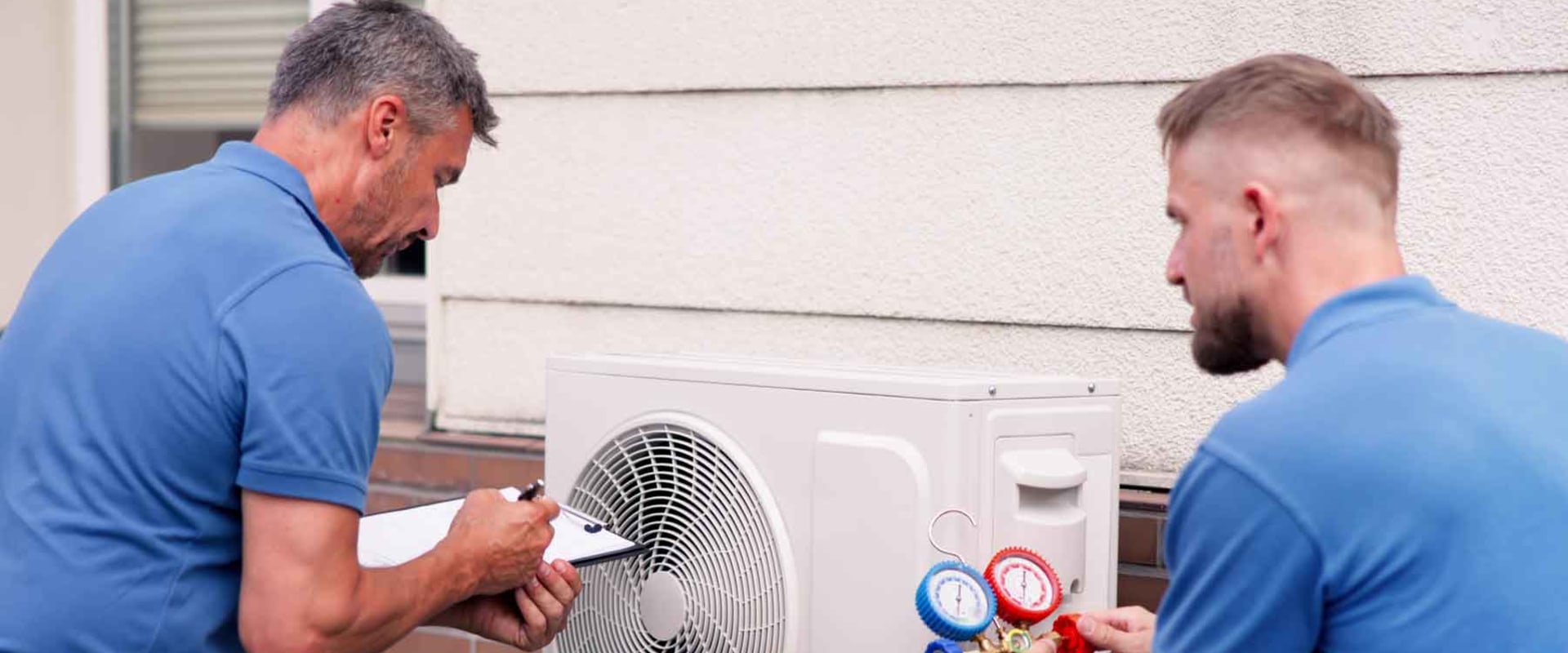
Deltona's housing stock makes this more consequential than most markets. Homes built in the 1980s and 90s — a large share of what exists here — carry variables that directly affect installation scope and cost: aging ductwork running through unconditioned attic spaces, older electrical panels, and non-standard layouts that add labor time a lump-sum quote never reflects. A number without a breakdown isn't a quote. It's a starting point for surprises.
This page gives you the framework we share with our own neighbors before they sign anything — what a complete, accurate estimate must include, what questions expose the gaps, and what the warning signs look like when a contractor is leaving something out, helping homeowners confidently choose top HVAC system installation near Deltona FL for reliable comfort and long-term efficiency.
TL;DR Quick Answers
How to Get an Accurate HVAC Installation Estimate in Deltona Without Getting Overcharged
Getting an accurate HVAC installation estimate in Deltona starts with knowing what a complete estimate must include — and what its absence tells you about the contractor providing it.
From our experience completing installations throughout Volusia County, the homeowners who avoid overcharges are the ones who ask the right questions before signing anything. Here's what that looks like in practice:
A complete Deltona HVAC installation estimate must include:
Equipment — make, model, and SEER2 rating in writing
Labor — broken out separately from equipment
Duct assessment — findings documented, repairs scoped
Permit fees — Volusia County mechanical permit pulled by the contractor
Old unit disposal — included, not assumed
Load calculation — Manual J method documented, not implied
The three questions that immediately separate thorough contractors from incomplete ones:
How did you determine system size? — Must reference a Manual J load calculation
Did you assess the ductwork? — Must include documented findings, not a visual check
Who is pulling the permit? — Must be the contractor, not the homeowner
What makes Deltona different from most markets:
Air conditioning accounts for 28% of total household energy use in Florida — more than triple the national average
A large share of Deltona homes were built in the 1980s and 90s with aging, undersized ductwork that directly affects new system performance
70 to 90 percent of residential HVAC systems have at least one performance fault at installation — when duct leakage is included, that rate approaches 100 percent
The best time to get an estimate in Deltona: Fall or late winter — before peak season removes your options, your flexibility, and your ability to choose the right system rather than the fastest available one.
Top Takeaways
Most HVAC overcharges in Deltona start with an incomplete estimate — not a dishonest contractor. Gaps that turn a competitive quote into an expensive surprise:
Missing line items
Skipped load calculation
Unassessed ductwork
Permit fees left out of the total
A documented Manual J load calculation is non-negotiable. An oversized system in Deltona's climate:
Short-cycles repeatedly
Fails to manage humidity
Wears out faster than a correctly sized system
Any contractor who skips the load calculation is skipping the step that determines whether the installation actually works.
Duct condition is the variable most Deltona homeowners don't know to ask about — and the one that matters most.
Homes from the 1980s and 90s frequently have aging, undersized, or poorly sealed ductwork
A new system installed on compromised ducts inherits the problem
70 to 90 percent of residential HVAC systems have at least one performance fault at installation
When duct leakage is included, that rate approaches 100 percent
Verify your contractor's Florida license before signing anything.
Florida's DBPR database confirms license status, profession type, and complaints on file
A contractor who asks you to pull your own Volusia County permit is one worth walking away from — regardless of price
The best time to get an accurate estimate is before a breakdown forces your hand. Planning ahead — in fall or late winter — gives you:
More time to compare quotes without pressure
Greater scheduling flexibility
Better pricing outside of peak season
The ability to choose the right system, not just the fastest available one
A Complete HVAC Estimate Covers More Than Equipment and Labor
From our experience reviewing quotes alongside Deltona homeowners, the most common source of sticker shock isn't the equipment cost — it's everything that wasn't mentioned upfront. A complete, accurate HVAC installation estimate should always itemize the following:
Equipment — make, model, and SEER rating specified in writing
Labor — broken out separately from equipment cost
Duct assessment — condition evaluation and any required repairs or replacement
Permit fees — Volusia County mechanical permit pulled by the contractor
Old unit disposal — removal and disposal of the existing system
Load calculation — the documented method used to determine correct system sizing
If any of those six items are missing from a quote, you don't yet have a complete picture of what the job will cost.
The Load Calculation Step Is Non-Negotiable
Oversizing is the most expensive mistake we see in Deltona installations — and it starts with skipping the load calculation. A properly documented Manual J calculation accounts for your home's insulation, window placement, ceiling height, duct layout, and local climate. Square footage alone tells a contractor very little about what your home actually needs.
An oversized system in a Deltona home doesn't just cost more upfront. It short-cycles, struggles with humidity, wears out faster, and drives up your energy bill every month it runs. Top HVAC system installation relies on a proper load calculation to prevent these issues and ensure the system is sized correctly. Any contractor who recommends a system size without one is skipping the step that determines whether the installation actually works.
Duct Condition Changes the Scope — and the Price — of Any Installation
In Deltona's older housing stock, duct condition is the variable that separates an accurate estimate from an incomplete one. Ductwork from the 1980s and early 90s was frequently undersized, poorly sealed, and routed through unconditioned attic spaces where Florida's summer heat worked against it around the clock.
When we assess a Deltona home before installation, duct condition is the first thing we evaluate — not because it always requires repair, but because it always affects the outcome. A new system installed on leaking or undersized ductwork will never perform to its rated efficiency. That performance gap shows up on your energy bill. A contractor who provides a quote without evaluating your ductwork is pricing the equipment, not the installation.
Permit Fees Belong in the Estimate — Not the Final Invoice
Every HVAC installation in Volusia County requires a mechanical permit. That permit fee should appear in your estimate before any work begins — not as a line item surprise on the final invoice. More importantly, your contractor should be pulling the permit, not asking you to.
In our experience, a contractor who asks the homeowner to secure the permit is often doing so because pulling it themselves creates an inspection record tied to their license. That's a risk you should not absorb. If it's not in the estimate, ask about it directly before signing.
How to Compare Estimates Without Getting Misled by the Lowest Number
When reviewing multiple quotes, the lowest number is rarely the most meaningful one. Here's what to compare instead:
Are all six line items present and broken out separately?
Does each quote specify the same equipment make, model, and SEER rating?
Is the load calculation documented and available upon request?
Does the estimate include duct assessment findings — not just a note that ducts were "checked"?
Are permit fees included, and is it clear the contractor is pulling the permit?
Two quotes for the same home can differ by thousands of dollars and both be legitimate — or one can be artificially low because it's missing scope the other correctly included. The line items tell you which is which.
Timing Your Estimate Request Affects What You'll Pay
Deltona contractors book solid from May through September. Requesting estimates during peak season means less contractor availability, compressed timelines, and in some cases, pricing that reflects high demand. Homeowners who request estimates in fall or late winter — when their system is aging but still running — consistently have more leverage, more options, and more time to evaluate their choices without pressure.
The best time to get an accurate estimate in Deltona is before you need an emergency replacement with a professional HVAC installation service. The worst time is July.
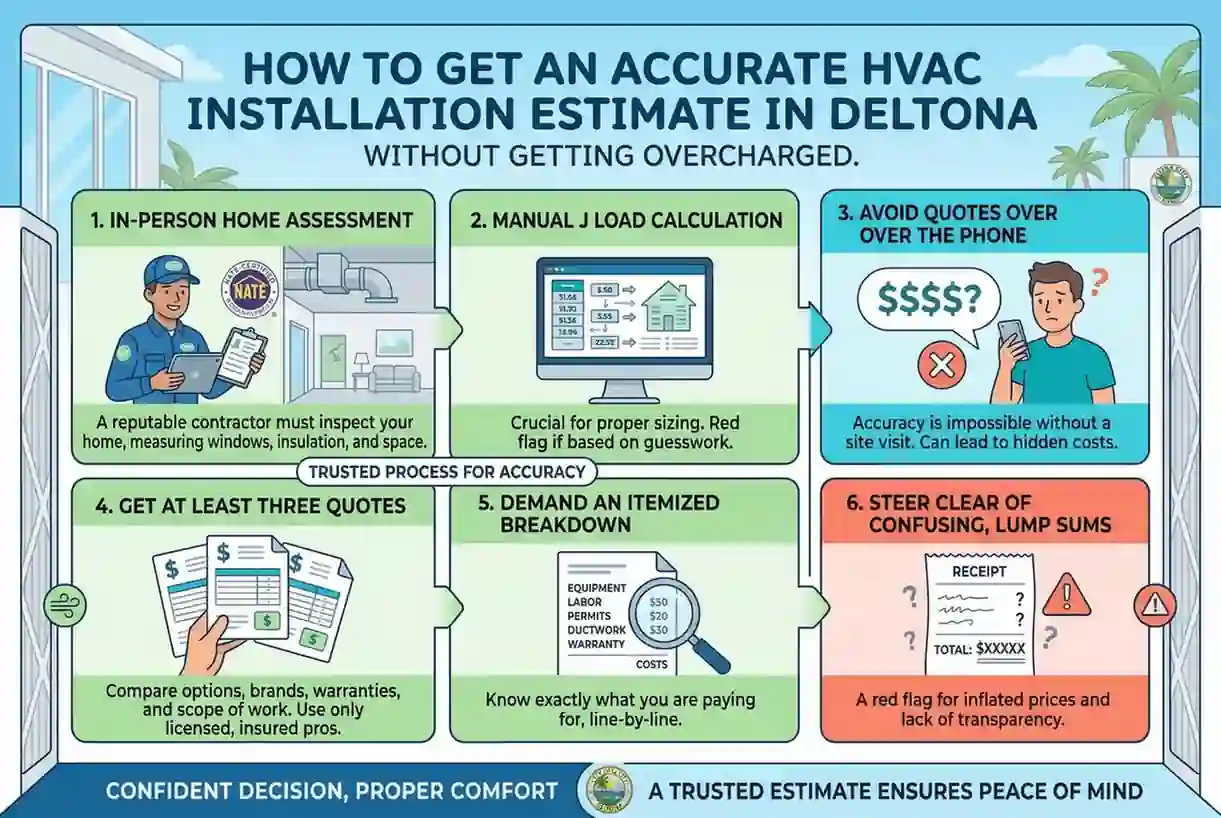
"In our experience walking through Deltona homes, the estimates that lead to overcharges almost never involve outright dishonesty — they involve omission. A contractor who leaves the duct assessment out of the scope isn't necessarily cutting corners on purpose. But the homeowner pays for that gap either way, whether it shows up as a mid-job change order or in an underperforming system they can't explain. The single most protective thing a Deltona homeowner can do before signing an installation estimate is ask for it line by line — equipment, labor, duct findings, permit fees, load calculation method, and disposal. If a contractor can't walk you through each of those items with confidence, the estimate isn't finished. And an unfinished estimate is how accurate quotes become expensive surprises."
Essential Resources
We put this list together because these are the exact resources we'd share with a neighbor sitting across the table from us. Whether you're comparing quotes for the first time or trying to figure out why one estimate is $3,000 lower than the others — this is the information that helps you make a confident, informed decision before signing anything.
1. Confirm Your Contractor Is Licensed to Work in Florida Florida DBPR — License Verification This is the first thing we'd tell any Deltona homeowner to do — and it takes less than a minute. Florida's license database lets you search any contractor by name or license number and see their current status, profession type, and any complaints on file. We've walked through enough homes in this area to know that unlicensed work happens more often than it should. A 60-second search before you commit is one of the simplest protections available to you. Florida DBPR License Search
2. Verify the Permit Process Before Work Begins in Volusia County Volusia County Building & Zoning — Permit Center Every HVAC installation in Volusia County requires a mechanical permit — and from our experience working in this market, a contractor who asks you to pull the permit yourself is one worth reconsidering. Your contractor should be pulling it. This resource confirms what's required in your jurisdiction and lets you verify that your installer is properly registered to do so before any work starts. Volusia County Permit Center
3. Understand What a Proper Load Calculation Requires — and Why It Matters ACCA — Manual J Residential Load Calculation Oversizing is the most common and most costly installation mistake we see in Deltona homes — and it almost always starts with skipping the load calculation. Manual J is the ANSI industry standard for determining the correct heating and cooling load for any residence. It accounts for insulation, window placement, ceiling height, duct layout, and local climate — not just square footage. If your contractor can't reference this standard when you ask how they sized your system, that's a conversation worth having before you sign. ACCA Manual J Standard
4. Know the Red Flags Before You Hire Any HVAC Contractor Federal Trade Commission — How to Avoid a Home Improvement Scam We'd rather our Deltona neighbors hear this from us directly than learn it the hard way: not every low quote reflects a better deal. The FTC's contractor guidance identifies the warning signs that separate trustworthy installers from those worth walking away from — asking you to pull your own permit, demanding full payment upfront, and skipping required documentation among them. Knowing these signs before you receive quotes puts you in a stronger position at every stage of the process. FTC — How to Avoid a Home Improvement Scam
5. Find Out If Your New System Qualifies for a Federal Tax Credit ENERGY STAR — Air Source Heat Pumps Tax Credit This is something we bring up with every Deltona homeowner we talk to right now. ENERGY STAR certified heat pumps installed between January 1, 2023, and December 31, 2025, qualify for a federal tax credit of 30% of project costs up to $2,000. If you're currently weighing system types, this resource can meaningfully change what your installation actually costs you out of pocket — and it's worth reviewing before you finalize any equipment decision. ENERGY STAR — Air Source Heat Pumps Tax Credit
6. Learn How Installation Quality Directly Affects What You Pay Every Month ENERGY STAR — Heat & Cool Efficiently In our experience diagnosing underperforming systems across Deltona, the equipment is rarely the problem. The installation is. ENERGY STAR's data confirms that improper installation can reduce system efficiency by up to 30 percent — driving up utility bills and shortening equipment life regardless of what was installed. This resource explains what a quality installation looks like and how to recognize whether the work was done correctly — before and after the job is complete. ENERGY STAR — Heat & Cool Efficiently
7. Compare Equipment Efficiency Ratings Before Reviewing Any Quote U.S. Department of Energy — Purchasing Energy-Efficient Residential Central Air Conditioners Florida's hot-humid climate falls under DOE regional efficiency standards updated January 1, 2023. The best available ENERGY STAR models can save up to $6,724 over the life of the equipment compared to less efficient options. We share this resource because understanding SEER2 ratings before you sit down with a quote means you're comparing systems on equal terms — not just reacting to a total price without context. U.S. DOE — Energy-Efficient Residential Central Air Conditioners
These resources help homeowners prepare for a professional HVAC installation by verifying contractor licensing, confirming permit requirements, understanding proper load calculations, identifying contractor red flags, reviewing efficiency standards, and exploring available tax credits before moving forward with a new system installation.
Supporting Statistics
When we assess a Deltona home before an HVAC installation, we're looking at everything that determines whether a new system will actually perform — ductwork, load calculation, installation quality, and every decision made before the first screw turns. The research below reflects what we see confirmed in real homes, every season we work in this market.
Between 70 and 90 percent of residential AC and heat pump systems have at least one performance-compromising fault from installation or inadequate maintenance. When duct leakage is factored in, that rate rises to 90 to 100 percent.
This is the statistic we think about every time a Deltona homeowner tells us their system "just doesn't keep up" — despite being replaced two or three years ago.
In our experience, the fault almost never involves defective equipment. It traces back to one of three gaps:
A skipped load calculation
An unassessed duct system
An installation that moved fast and cut corners that didn't show until the first full Florida summer
A complete, itemized estimate — one that includes duct findings and a documented load calculation — is what separates a quality installation from one that joins this statistic.
U.S. Department of Energy — Residential HVAC Installation Practices: A Review of Research Findings
Most HVAC equipment is planned without a proper load calculation and is routinely oversized. The U.S. Department of Energy confirms oversizing leads to reduced efficiency, accelerated equipment wear, and chronically elevated indoor humidity.
Deltona's humidity makes oversizing more consequential here than in most markets.
A short-cycling system never runs long enough to pull moisture from the air. In a Central Florida summer, that's a comfort failure no thermostat setting will fix.
From our work in this area, contractors oversize for one reason above all others: it reduces callbacks. What it won't do is:
Cool the home efficiently
Manage humidity effectively
Last as long as a correctly sized system
Requiring a documented Manual J calculation before agreeing to any system recommendation is not an unreasonable ask. It's the standard. Any contractor who treats it as optional is telling you something important about how they work.
U.S. Department of Energy — HVAC Sizing Research
Correcting duct sealing and insulation alone produces up to a 33 percent improvement in cooling capacity and 16 to 41 percent improvement in seasonal efficiency. Combined with airflow and refrigerant charge corrections, total energy savings range from 12 to 47 percent.
We've sat with Deltona homeowners ready to replace a system only three or four years old — convinced the equipment was failing.
In more than a few of those cases, the system wasn't the problem. The duct condition it was installed on top of was.
That performance gap lives in your energy bill every month — not as a one-time cost, but as an ongoing one.
In Deltona's older housing stock, duct condition is the variable that most directly determines whether the estimate you signed was actually for the installation your home needed.
ACEEE — Increasing Uptake of Residential HVAC Commissioning with Advanced Technologies
These statistics show how a properly executed HVAC system installation service directly impacts system performance by addressing load calculations, duct condition, and installation quality—factors that determine cooling efficiency, humidity control, and long-term reliability in homes with heavy air-conditioning demand.
Final Thoughts
After completing installations across hundreds of Volusia County homes, one pattern stands out above everything else: homeowners who got overcharged almost never got cheated by an obviously bad contractor. They got overcharged by an incomplete process.
An incomplete estimate isn't always a dishonest one. It's often the product of:
A contractor who skips the load calculation because they're busy
A duct assessment omitted because it takes time
Permit fees left out of the total because it simplifies the sale
The homeowner sees a competitive number. What they don't see is everything that number doesn't include.
Our honest perspective, shaped by years of working specifically in this market:
The most expensive HVAC installation mistake a Deltona homeowner can make isn't:
Choosing the wrong equipment brand
Choosing the wrong system type
It's signing an estimate that wasn't built on a complete picture of what the job actually requires — and discovering the gap after work has already started.
Why Deltona's housing stock makes this more consequential than most markets:
Homes built in the 1980s and 90s carry variables a contractor who skips the assessment phase will never account for:
Aging ductwork running through unconditioned attic spaces
Older electrical panels that may require upgrades
Non-standard layouts that add labor time no lump-sum quote reflects
Those variables don't disappear because they weren't quoted. They surface as:
Change orders mid-job
Underperforming systems post-installation
Energy bills that don't reflect the investment made
What a complete, accurate estimate looks like — and the standard every Deltona homeowner deserves:
Every line item present and broken out separately
System size documented through a Manual J load calculation
Duct condition honestly assessed and reflected in the scope
Florida contractor license verified before signing anything
That combination is what an accurate estimate looks like. It's also what a quality installation starts with.
Anything less isn't a better deal. It's an incomplete one.
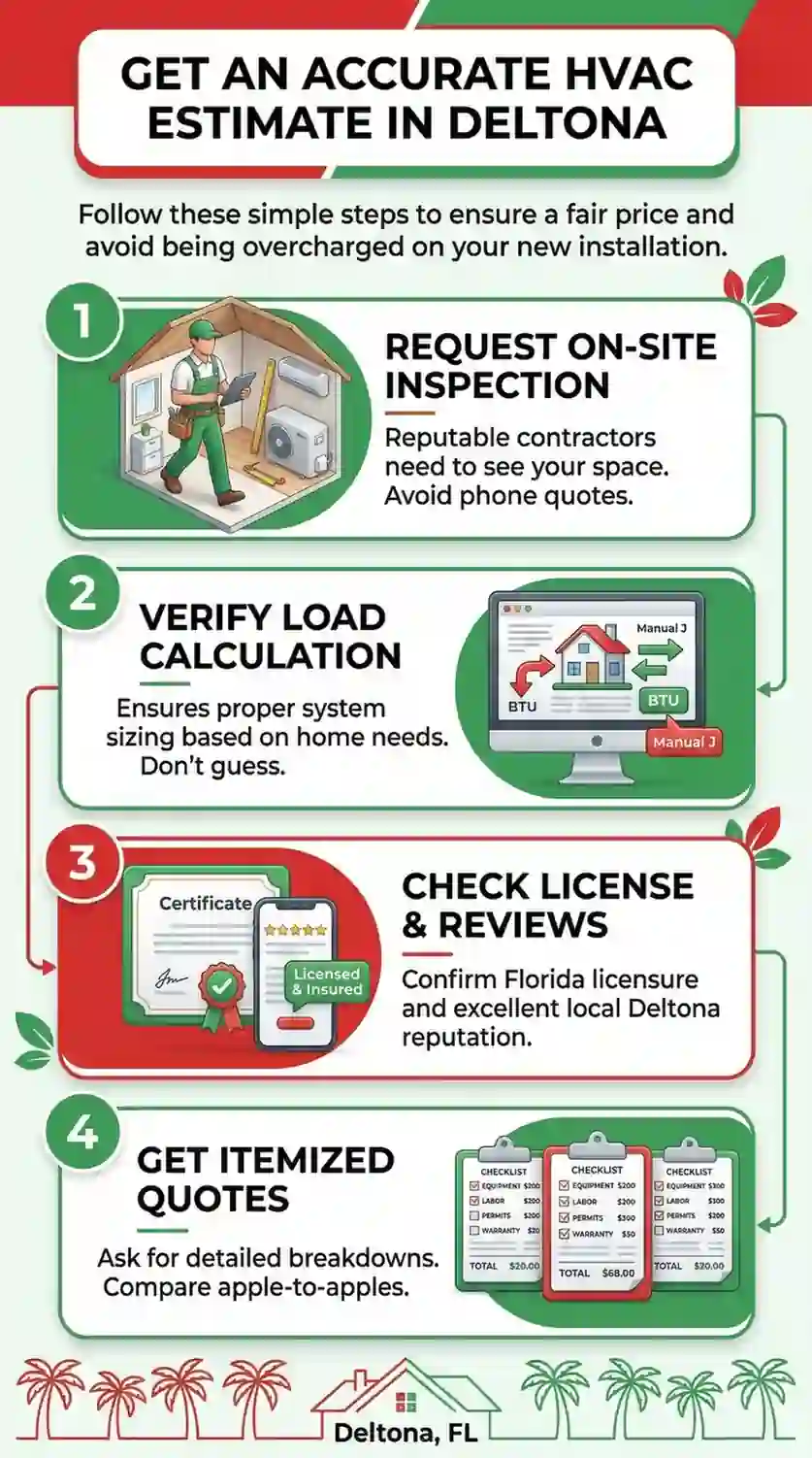
FAQ on How to Get an Accurate HVAC Installation Estimate in Deltona Without Getting Overcharged
Q: What should an accurate HVAC installation estimate in Deltona include?
A: After reviewing estimates alongside Deltona homeowners for years, the ones that led to overcharges almost always shared the same problem — missing line items. A complete estimate must include all six of the following, each broken out separately:
Equipment — make, model, and SEER2 rating specified in writing
Labor — broken out separately from equipment cost
Duct assessment — findings documented, repairs or replacement scoped
Permit fees — Volusia County mechanical permit pulled by the contractor
Old unit disposal — removal included, not assumed
Load calculation — Manual J method documented, not implied
A lump-sum number with no line items tells you very little about what you're actually buying. If a contractor can't walk through each item clearly — the estimate isn't finished. An unfinished estimate is how accurate quotes become expensive surprises.
Q: How do I know if an HVAC contractor in Deltona is overcharging me?
A: In our experience, overcharging in this market rarely looks like obvious price gouging. It looks like an omission. Warning signs to watch for before signing any estimate:
A quote significantly lower than others with no explanation for the gap
No duct assessment included in the scope of work
No reference to a load calculation or how system size was determined
Permit fees missing from the total
A lump-sum price with no itemized breakdown
Two estimates for the same Deltona home can differ by thousands of dollars and both be legitimate — or one can be artificially low because it's missing scope the other correctly included. The line items tell you which is which. If a contractor can't explain each one clearly — the estimate isn't done.
Q: Why does duct condition affect my HVAC installation estimate in Deltona?
A: Duct condition is the variable that most directly determines whether a new system performs the way it's rated. It's also the variable most Deltona homeowners don't know to ask about — until after installation day.
Deltona's 1980s and 90s housing stock commonly has ductwork that is:
Undersized for the home's actual layout
Poorly sealed at connections and joints
Routed through unconditioned attic spaces where Florida heat works against efficiency year-round
What we've seen in the field:
Systems only three years old already underperforming
Equipment that tested fine — duct condition that didn't
DOE research confirming duct leakage causes an average 37 percent cooling efficiency loss — even in newly built homes
In Deltona's older housing stock, that number trends worse. Any estimate without a documented duct assessment is missing the variable that most affects what you'll experience after installation day.
Q: What questions should I ask before signing an HVAC installation estimate in Deltona?
A: These are the five questions we'd tell any Deltona neighbor to ask before signing anything:
How did you determine system size? The answer must reference a Manual J load calculation — not square footage, not the old system's size, not a rule of thumb.
Did you assess the existing ductwork? Ask for findings in writing. A visual check is not a documented assessment.
Are permit fees included — and who is pulling the permit? Your contractor must pull the Volusia County mechanical permit. If they're asking you to do it — ask why, and consider walking away.
Is this estimate fully itemized? Equipment, labor, duct work, permits, and disposal must each appear as separate line items with individual costs.
Can I verify your Florida license? Any reputable contractor provides their license number without hesitation. Verify it at myfloridalicense.com before signing.
A contractor who answers all five confidently is worth your continued attention. One who deflects or can't explain the load calculation is telling you something important about how they work.
Q: When is the best time to get an HVAC installation estimate in Deltona, FL?
A: Fall and late winter. When a system fails in July, every advantage a planned installation provides disappears. Here's what changes when you plan ahead:
More contractor availability Deltona contractors book solid May through September. Off-peak scheduling means more options and no timeline pressure.
More time to compare estimates properly Reviewing three itemized quotes without a failing system forcing a decision is a fundamentally different experience than doing it under peak-season pressure.
Potentially better pricing Reduced seasonal demand outside of peak months creates more room for competitive quotes.
The ability to choose the right system Not just the fastest available one that fits a budget under pressure.
If your system is more than 10 years old:
Fall is when to start the conversation
Don't wait for a breakdown in a Florida summer to remove every option a little planning would have preserved
When homeowners compare quotes, the article Why Do HVAC Installation Costs Vary So Much in Deltona, FL? explains that installation pricing often changes based on factors such as system size, duct condition, home layout, and the level of work required to ensure the system performs correctly after installation. While choosing the right equipment is important, long-term efficiency also depends on proper airflow and filtration throughout the HVAC system. Using quality filters like the 21x21x1 pleated furnace air filter helps trap dust and airborne particles before they circulate through the home. Standard replacements such as the 15x20x1 MERV 8 HVAC air filter are designed to capture up to about 90% of dust and common particles while maintaining proper airflow through the system. For homeowners exploring additional filtration options, the MERV 11 HVAC replacement air filter provides another compatible choice that can complement a properly installed HVAC system, helping maintain cleaner air and consistent system performance throughout the home.