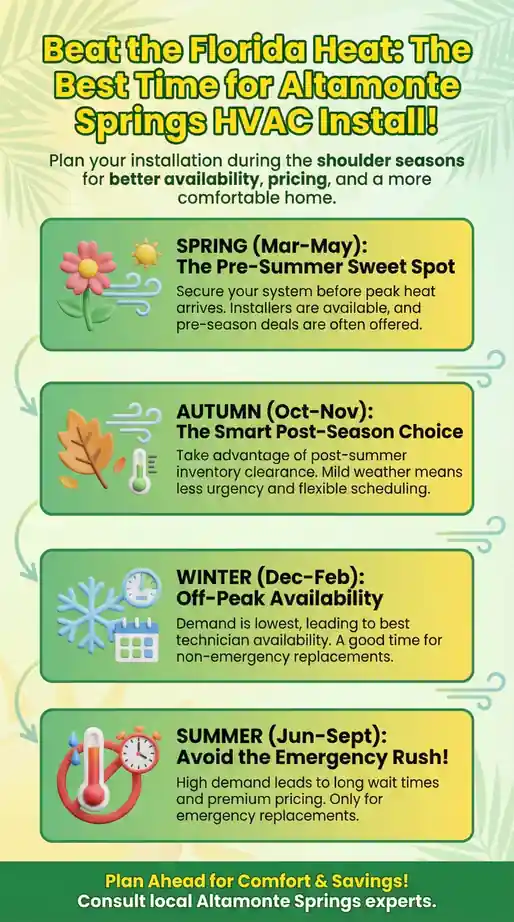
After completing installations across this community through every month of the calendar year, the timing patterns that actually matter for Altamonte Springs homeowners have become clear. Spring and fall still represent the best windows — but not for the reasons most articles cite. The real advantages are contractor availability, rebate eligibility cycles, and the ability to run a proper pre-installation duct assessment without the pressure of a system that failed during a July heat wave driving every decision.
What we've learned from being on the reactive end of summer emergency calls is this: the installations completed under urgency are the ones most likely to skip the load calculation, connect to unassessed ductwork, and miss the rebate window entirely. The homeowner pays more for the equipment, more to install it, and more to run it — because timing compresses every step that protects against those outcomes.
In a market where your system runs the majority of the year, the window between "planning an upgrade" and "replacing a failed system" is shorter than most homeowners expect. This guide explains what the best installation timing actually looks like in Altamonte Springs — and why getting ahead of the decision for top HVAC system installation near Altamonte Springs FL is the one move that consistently produces better outcomes for the homeowners we serve in this community.
TL;DR Quick Answers
Top HVAC System Installation Near Altamonte Springs FL
Finding top HVAC installation in Altamonte Springs starts with one step most homeowners skip: verifying the contractor's active Florida license at myfloridalicense.com before any conversation begins.
What separates a top installation from an average one in this market:
Manual J load calculation completed before equipment is recommended
Existing ductwork assessed and leakage-tested before new equipment is connected
Seminole County mechanical permit pulled as standard — not optional
Refrigerant and airflow verified to manufacturer specs with written documentation after installation
Why it matters more here than most U.S. markets:
Altamonte Springs systems run 10+ months per year
Florida households pay nearly double the national average for AC — $525 vs. $265 annually (EIA)
Improper installation forces systems to consume 20–30% more energy than rated (DOE)
A properly installed mid-tier system outperforms an improperly installed premium system every month for 15 years
Financial incentives available to Altamonte Springs homeowners:
Duke Energy Florida: up to $1,000 back on qualifying HVAC replacement
IRS Section 25C: up to $2,000 on qualifying heat pumps, up to $600 on qualifying AC
Additional incentives searchable by ZIP code at dsireusa.org
The bottom line: in Altamonte Springs, the quality of the installation process determines what you pay every month — not the brand name on the equipment. The best time to schedule is before urgency removes the option to do it correctly. The bottom line: in Altamonte Springs, the quality of the installation process determines what you pay every month — not the brand name on the equipment. The best time to schedule is before urgency removes the option to do it correctly.
Top Takeaways
1. The Best Time to Install Is Before You Have To
Planned installations consistently outperform reactive ones in Altamonte Springs.
Best windows: February–April and September–November
These months offer contractor availability, rebate access, and time to do every step correctly
A July failure compresses every decision that affects long-term performance
2. Installation Quality Determines What You Pay — Not Brand or Rating
65%+ of residential HVAC systems are improperly installed from day one (DOE)
Improper installation forces systems to consume 20–30% more energy than rated
A properly installed mid-tier system outperforms an improperly installed premium system every month
The four non-negotiables every Altamonte Springs installation must include:
Manual J load calculation
Duct leakage testing before connection
Refrigerant verification to manufacturer specs
Post-installation airflow confirmation
3. Florida's Climate Makes Every Decision More Consequential
Altamonte Springs systems run 10+ months per year vs. 4–5 months in northern markets
Florida households pay $525/year for AC vs. $265 national average — nearly double (EIA)
Every efficiency point lost compounds across more operating hours than almost any U.S. market
Payback on a properly installed system is faster here than almost anywhere in the country
4. Real Money Is Available — But Only With a Planned Timeline
Duke Energy Florida: up to $1,000 back — requires Home Energy Check before installation
IRS Section 25C: up to $2,000 on qualifying heat pumps, up to $600 on qualifying AC
DSIRE: additional state, utility, and local incentives searchable by ZIP code
Every program has prerequisites and deadlines that only work on a planned timeline
5. Verify Three Things Before Any Installation Is Scheduled
Confirm an active Florida contractor license at myfloridalicense.com
Confirm a Seminole County mechanical permit will be pulled before work begins
Confirm equipment meets current SEER2 minimums and qualifies for rebates and tax credits
In Central Florida's climate, the process matters as much as the equipment. Both matter more here than almost anywhere else in the country.
Most of the country installs HVAC systems reactively — the unit fails, the homeowner calls, and whoever is available shows up. In Altamonte Springs, that pattern is more expensive than it is elsewhere because the stakes of a rushed installation compound across a longer operating season than almost any other U.S. market.
Choosing when to install isn't just a scheduling preference. It directly affects contractor availability, installation quality, rebate eligibility, and what you pay for equipment. In a climate where your system runs 10-plus months per year, those variables matter more here than they do in a market where HVAC is truly seasonal.
The Two Best Windows for HVAC Installation in Altamonte Springs
From completing installations across this community through every month of the calendar year, two windows consistently produce the best outcomes for homeowners — and neither of them is midsummer.
Late February through April — Early Spring
This is the window we recommend most often. Contractor schedules are manageable. Equipment lead times are shorter. Rebate programs through Duke Energy and FPL are typically fully funded and accessible. Most importantly, the homeowner has time — time for a proper Manual J load calculation, a duct assessment before connection day, and a post-installation verification before the first real demand of the cooling season arrives.
What we see in early spring installations that we don't always see in emergency summer replacements: every step gets completed in the right sequence. The load calculation happens before equipment is ordered. The ductwork gets evaluated before the new system is connected. Refrigerant charge gets verified before the technician leaves. That sequence produces a system that's performing at rated efficiency from day one of the peak season — not struggling through it.
September through November — Early Fall
The second-best window is the stretch after the peak cooling demand drops but before the end-of-year rush on contractor schedules. Altamonte Springs doesn't experience a true winter in the sense that most of the country does, but October and November bring the community's closest equivalent to off-season conditions.
For homeowners whose systems made it through summer but showed strain — longer run times, higher bills, inconsistent humidity control — this window allows a planned replacement rather than a reactive one. The urgency that compresses installation quality in summer is gone. The rebate programs are still active. And a new system installed in October is commissioned, verified, and fully broken in before the following spring's cooling season begins.
Why Summer Installations Cost More and Deliver Less
June through August represents peak demand for HVAC contractors across Central Florida. This isn't a minor scheduling inconvenience — it's a market condition that affects installation quality in ways most homeowners never consider.
When contractor schedules are compressed, the steps most likely to get shortened are the ones that take the most time: the pre-installation duct assessment, the post-installation refrigerant verification, the airflow confirmation. These aren't optional steps. They're the difference between a system that performs at its rated efficiency and one that quietly underperforms for years.
What summer urgency typically costs Altamonte Springs homeowners:
Reduced contractor availability means less leverage to choose who does the work
Equipment lead times extend — inventory moves faster during peak season
Rebate program funding can be depleted or processing times extended
Installation steps get compressed under schedule pressure
Load calculations get estimated rather than calculated when a household is without cooling
We're not suggesting summer installations can't be done correctly — we complete them throughout the season. The point is that a planned installation in spring or fall removes the conditions that lead to shortcuts.
How Rebate and Tax Credit Timing Affects Your Decision
Installation timing intersects directly with financial incentives — and most homeowners miss this connection until after equipment has been ordered.
Duke Energy Florida's rebate program requires a free Home Energy Check to be completed within 24 months before installation to qualify for up to $1,000 back on a qualifying replacement. That prerequisite takes planning. A homeowner who decides to replace their system on a Wednesday in July because the unit failed doesn't have the timeline to meet that requirement without prior preparation.
FPL's instant invoice credit of $200 on qualifying systems is applied at time of purchase — but only through approved contractors. Confirming contractor approval status before scheduling, not after, is the step that determines whether that credit is accessible.
The federal IRS Section 25C tax credit — up to $2,000 on qualifying heat pumps and up to $600 on central air conditioners — requires the system to be installed within the qualifying tax year. For homeowners planning a replacement, scheduling installation to fall within a specific tax year is a decision that only works if the timeline is planned in advance.
The Aging System Warning Signs That Should Trigger a Timing Decision
The homeowners who get the best installation outcomes in Altamonte Springs aren't the ones who wait for failure. They're the ones who recognize the signs of a system approaching end of life and make the replacement decision on their own schedule — not the system's.
Signs that should prompt a planned replacement conversation:
System is 12 to 15 years or older
Energy bills have been trending upward without a change in usage patterns
System required refrigerant recharge in the past 12 months
Humidity control has become inconsistent — rooms feel clammy at the correct set point
Repair costs in the past two years have exceeded 30-40% of replacement cost
System struggles to maintain set temperature during peak afternoon heat
Any one of these indicators in an Altamonte Springs home is worth a free assessment conversation. Two or more together typically point toward a replacement decision that will be made either on the homeowner's timeline or the systems — and one of those options consistently produces better outcomes.
What the Best-Timed Installations in This Community Have in Common
After completing installations across every season in Altamonte Springs, the ones that consistently deliver the best long-term results share a clear set of characteristics — and most of them trace back to the homeowner having enough time to do the process correctly.
What planned installations allow that reactive ones often don't:
Manual J load calculation completed before any equipment is selected or ordered
Duct system assessed and leakage-tested before the new unit is connected
Multiple contractor quotes with time to verify licenses and check local references
Rebate program prerequisites confirmed and completed before installation day
Equipment ordered with adequate lead time — not pulled from whatever is available
Post-installation verification completed without schedule pressure
The best time to install an HVAC system in Altamonte Springs is the window that gives you enough time to do all of these things right. For most homeowners, that means late winter through early spring or early fall — before the conditions that compress quality and inflate cost take over, and when you can plan a top HVAC replacement with the right system, the right install, and the best long-term value.
"The calls we dread most aren't the difficult installations — they're the ones that didn't have to happen the way they did. A homeowner without cooling in the middle of a Central Florida summer doesn't have the luxury of waiting for the right contractor, verifying the load calculation, or checking whether their duct system can support the equipment being recommended. They need a system running, and they need it today. We've completed those installations, and we've done them correctly — but the homeowner who planned ahead in March got a better process, better pricing, better rebate access, and a system that was verified from day one. In Altamonte Springs, where your system runs most of the year, the timing of the decision is part of the installation quality. You can't separate them."
Essential Resources
Making a smart installation decision starts well before anyone steps foot in your home. These are the resources we point every Altamonte Springs homeowner toward — the same ones we use ourselves to verify contractors, confirm permits, understand what proper HVAC installation requires, and make sure every dollar of available incentive is captured before equipment is ordered.
1. Confirm Your Contractor Holds an Active Florida License
Florida's Department of Business and Professional Regulation maintains a free public database where you can verify any contractor's license status, license number, and disciplinary history in under two minutes. In Florida, only a licensed mechanical or air conditioning contractor can legally perform an HVAC installation — and a business card isn't the same as an active, verified license.
Check before the conversation goes any further.
Florida DBPR License Verification: https://www2.myfloridalicense.com/
2. Know That a Permit Is Required for Every Installation in Seminole County
Florida Statute 489 requires a mechanical permit for every HVAC installation and system replacement — no exceptions. The Seminole County Building Division portal lets you confirm permit requirements and verify the status of any active permit pulled for work at your address. Unpermitted installations void most manufacturer warranties and create real liability when you sell your home.
The right question to ask any contractor before scheduling: "Will you pull the permit?"
Seminole County Building Department: https://www.seminolecountyfl.gov/departments-services/development-services/building
3. Understand What a Quality Installation Actually Requires
The EPA's ENERGY STAR HVAC Quality Installation program defines the specific steps every installation must include to deliver the efficiency it's rated for. It confirms that improper installation reduces system performance by up to 30% — and outlines exactly what prevents that: a full load calculation, duct leakage testing, refrigerant verification, and post-installation airflow confirmation. This is the standard we hold ourselves to on every job in Altamonte Springs.
ENERGY STAR HVAC Quality Installation: https://www.energystar.gov/saveathome/heating-cooling/hvac-quality-installation
4. Verify Your Equipment Meets Florida's Current Efficiency Standards
Florida carries stricter federal SEER2 minimums than most of the country. The ENERGY STAR Certified Product Finder lets you independently confirm that any equipment a contractor recommends meets current certification requirements — and whether it qualifies for federal tax credits and utility rebates. Confirm before equipment is ordered, not after.
ENERGY STAR Certified Product Finder: https://www.energystar.gov/productfinder/product/certified-central-air-conditioners-heat-pumps/
5. Claim Up to $1,000 Back Through Duke Energy's Home Energy Improvement Program
Duke Energy Florida customers can receive up to $1,000 in rebates on qualifying HVAC replacements — but the program requires a free Home Energy Check completed within 24 months before installation. That prerequisite is the detail most homeowners miss until after the equipment is already in. As of May 2025, the program has expanded, making this one of the most significant financial resources available to Altamonte Springs homeowners planning a replacement.
Confirm eligibility before you schedule — not after.
Duke Energy HVAC Rebate Program: https://www.duke-energy.com/Home/Products/Home-Energy-Improvement/HVAC-Replacement?jur=FL01
6. Reduce Your Federal Tax Bill by Up to $2,000 on a Qualifying Heat Pump
The IRS Section 25C Energy Efficient Home Improvement Credit gives homeowners a 30% federal tax credit on qualifying HVAC equipment — up to $2,000 for heat pumps and up to $600 for qualifying central air conditioners installed in your primary residence. There is no lifetime dollar limit. The credit resets annually. Combined with utility rebates, the total financial incentive for a planned heat pump installation in Altamonte Springs can be substantial.
Confirm credit eligibility with your contractor and tax advisor before equipment is selected.
IRS Section 25C Energy Efficient Home Improvement Credit: https://www.irs.gov/credits-deductions/energy-efficient-home-improvement-credit
7. Search Every Available Incentive for Your Address in One Place
The Database of State Incentives for Renewables and Efficiency (DSIRE) — maintained by North Carolina State University with U.S. Department of Energy funding — is the most comprehensive source of energy efficiency incentives in the country. Search by ZIP code and it returns every applicable federal, state, utility, and local program for your address: rebates, tax credits, financing programs, and equipment standards. Use it before any installation decision is finalized to make sure nothing is left on the table.
DSIRE — Database of State Incentives for Renewables and Efficiency: https://www.dsireusa.org/
These essential resources help Altamonte Springs homeowners confidently plan a top HVAC installation by verifying licensing and permits, following proven quality-installation standards, confirming efficiency compliance, and maximizing every available rebate or tax credit—so the entire decision is optimized for comfort, performance, and long-term value from day one.
Supporting Statistics
The data behind this guide comes from federal research agencies, government energy surveys, and peer-reviewed engineering studies conducted on real homes in real climate conditions — not HVAC marketing materials.
More Than 65% of Residential HVAC Systems Are Improperly Installed From Day One
The U.S. Department of Energy estimates more than 65% of residential HVAC systems are improperly installed and operating below rated efficiency from day one.
The most common installation faults found in the field:
Insufficient indoor coil airflow
Incorrect refrigerant charge
Duct systems leaking conditioned air before it reaches living space
What the research shows:
Improper installation causes systems to consume 20–30% more energy than necessary (NREL)
An estimated 1.6 quadrillion BTU is wasted annually across U.S. households as a result
When duct leakage is factored in alongside other faults, the rate of systems with at least one performance-compromising fault rises to 90–100% (DOE Building America)
NIST identified duct leakage as the single most impactful installation error
Refrigerant undercharge and low indoor airflow from undersized return ductwork follow closely behind
In Altamonte Springs, where systems run the majority of the year, a 20–30% efficiency penalty is not a seasonal inconvenience — it is a recurring monthly cost that compounds across every billing cycle for the life of the system, which is why professional HVAC installation is the advantage that protects efficiency, comfort, and long-term operating costs from day one.
These faults don't surface on installation day. They appear on every utility bill afterward.
Source: U.S. Department of Energy — Field Study to Characterize Fault Prevalence in Residential Comfort Systems https://www.energy.gov/eere/buildings/field-study-characterize-fault-prevalence-residential-comfort-systems
Supporting Source: DOE Building America Solution Center — Heat Pump Quality Installation and Commissioning https://basc.pnnl.gov/resource-guides/heat-pump-quality-installation-and-commissioning
Improper HVAC Installation Costs U.S. Homeowners an Estimated $2.5 Billion in Wasted Energy Every Year
An NREL model estimated that approximately 9% of total residential HVAC energy nationwide is attributable to installation faults alone — faults that exist from startup, not from wear over time.
The national financial impact:
$2.5 billion in unnecessary utility costs annually across U.S. households
Even modest deviations from manufacturer specs produce measurable, ongoing efficiency losses (NIST TN 1848)
A 15% airflow reduction or 20% refrigerant undercharge — both common field findings — each produce significant energy penalties on their own
When duct leakage and refrigerant undercharge occur together, the energy penalty is well beyond additive
The process used to install the system determines what you pay every month.
Those costs begin on installation day — not after the equipment ages.
Getting installation right from day one is the single highest-return decision available in this market.
For Altamonte Springs homeowners planning installations during spring or early fall, this data makes the case plainly: proper timing creates the conditions for proper process, and proper process is what determines long-term cost.
Source: NIST Technical Note 1848 — Sensitivity Analysis of Installation Faults on Heat Pump Performance https://www.nist.gov/publications/sensitivity-analysis-installation-faults-heat-pump-performance
Supporting Source: DOE — Optimizing the Installed Performance of Residential HVAC Systems (NREL) https://www.energy.gov/eere/buildings/articles/optimizing-installed-performance-residential-hvac-systems
Florida Households Pay Nearly Double the National Average for Air Conditioning
EIA's Residential Energy Consumption Survey confirms Florida's cooling costs are among the highest in the country — and Altamonte Springs systems run 10 or more months per year.
The numbers:
Florida households pay an average of $525/year for air conditioning
The national average is $265/year — Florida pays nearly double
96% of Florida households use air conditioning — the highest rate in the nation
90% of those households rely on central systems
Air conditioning accounts for 28% of total site energy in Florida homes vs. 9% nationally
Florida's residential sector consumes 54% of all electricity used in the state — the largest share of any state
What this means for Altamonte Springs specifically:
Every installation shortcut applies its cost penalty across 10+ months of active operation
Northern U.S. markets absorb the same penalty across only 4–5 months
A 20–30% efficiency loss in a 10-month cooling climate is not a minor variance — it is a significant recurring annual cost that persists for the life of the system
Homeowners who plan their installation — choosing spring or early fall windows, completing the process correctly before peak demand compresses every decision — are the ones positioned to capture maximum rebate value and maximum efficiency from the first billing cycle forward.
Source: U.S. Energy Information Administration — Air Conditioning Accounts for About 12% of U.S. Home Energy Expenditures https://www.eia.gov/todayinenergy/detail.php?id=36692
Supporting Source: U.S. Energy Information Administration — Florida State Energy Profile https://www.eia.gov/state/print.php?sid=FL
Final Thought
We've completed installations across every month of the calendar year in this community. We've seen what planned replacements look like. We've seen what a failed system in July forces on a homeowner. The difference between those two experiences isn't luck.
It's timing — and what timing makes possible.
The honest opinion we share with every Altamonte Springs homeowner who asks:
The best time to install is the moment you have enough time to do it correctly. That window closes faster than most homeowners expect.
What years of local installations have taught us:
The homeowners who fare best aren't always the ones with the biggest budgets. They're the ones who made the decision before urgency made it for them.
A system installed in March — proper load calculation, assessed ductwork, verified refrigerant, confirmed rebate — will outperform a system installed in August under schedule pressure. Every time.
The permits, calculations, duct assessments, and rebate prerequisites aren't difficult steps. Every one of them requires time. Time is the one thing a July failure doesn't give you.
What the industry doesn't say clearly enough:
Most HVAC guides focus on equipment. Which brand? Which SEER2 rating. Which features. That's the wrong starting point.
In Altamonte Springs, equipment choice matters less than most homeowners think. A properly installed mid-tier system will outperform an improperly installed premium system — on day one and every day after.
The decision that determines what you pay for the next 15 years:
How thoroughly the contractor assessed your home before recommending equipment
How carefully the installation was verified before the technician left
Our perspective on timing:
The industry reinforces the idea that HVAC replacement is something you deal with when the system fails. We understand why. It's an expensive purchase most homeowners would rather not think about until they have to.
But in Central Florida's climate, that approach consistently produces worse outcomes — not because the equipment is different, but because the process is compressed:
The contractor who can properly assess your duct system in April is juggling emergency calls in July
The rebate program that requires a Home Energy Check 24 months in advance doesn't make exceptions for summer failures
The federal tax credit window closes December 31st regardless of when your old system gave out
What we've come to believe most firmly:
In Altamonte Springs, an HVAC installation is not primarily a comfort decision. It's a financial decision with a 15-year time horizon.
Every efficiency point recovered from a properly installed system compounds across 10+ months of operation, year after year. Homeowners who treat installation with the same deliberateness they'd bring to any long-term investment consistently see:
Lower monthly bills
Fewer callbacks and repairs
Systems that actually deliver the efficiency the rating promised
The ones who plan ahead get the process. The ones who wait for failure get whatever's available.
We'd rather every Altamonte Springs homeowner get the process. Free, no-pressure estimates are available 7 days a week — because the best time to have this conversation is before the decision becomes urgent.
FAQ on Top HVAC System Installation Near Altamonte Springs FL
Q: How do I find a top-rated HVAC installation company near Altamonte Springs FL?
A: Start with license verification — not reviews, not referrals.
Confirm any contractor's active Florida license at myfloridalicense.com before the conversation goes further. We verify our own licensure with every homeowner we speak with.
Four practices that separate quality installers from the rest:
Manual J load calculation before any equipment recommendation
Ductwork assessed and leakage-tested before new equipment is connected
Seminole County mechanical permit pulled without being asked
Refrigerant and airflow verified to manufacturer specs after installation — with written documentation
From years of completing installations in this community: homeowners with the most persistent performance problems didn't always choose the cheapest contractor. They chose one who skipped one of these four steps. The savings on installation day became recurring costs on every bill after.
Q: What does a proper HVAC installation in Altamonte Springs actually include?
A: More than most contractors deliver — and more than most homeowners know to ask for.
A proper installation has three phases:
Before installation:
Manual J load calculation specific to your home — not the neighborhood average
Duct system assessed and leakage-tested before anything new is connected
Equipment selected based on calculated load and confirmed rebate eligibility
During installation:
Mechanical permit pulled and on file
Refrigerant charged to manufacturer specs with accurate gauges
Indoor and outdoor units connected to assessed ductwork
After installation:
Airflow measured and confirmed against design specs
Post-installation diagnostics reviewed with the homeowner
Written documentation provided before the technician leaves
From working across Altamonte Springs homes: the most commonly skipped step is duct assessment before connection. A new high-efficiency system connected to ductwork leaking 25–30% of its output will never perform to its rating. The equipment gets blamed. The ductwork was the problem from day one.
Q: How much does HVAC installation cost in Altamonte Springs FL?
A: Most Altamonte Springs homeowners pay between $5,000 and $12,000 for a complete system replacement. Homes needing ductwork alongside new equipment typically fall between $8,000 and $15,000.
What moves that number most:
System size — determined by Manual J, not square footage
SEER2 efficiency tier of selected equipment
Duct condition — assessment, repair, or replacement needed
Whether permits, verification, and documentation are included
Three resources that reduce net cost — but only with a planned timeline:
Duke Energy Florida: up to $1,000 back — requires a free Home Energy Check before installation
IRS Section 25C: up to $2,000 on qualifying heat pumps, up to $600 on qualifying AC
DSIRE at dsireusa.org: additional state, utility, and local incentives searchable by ZIP code
From walking homeowners through this process: most don't realize rebate eligibility has prerequisites until after equipment is ordered. Confirm eligibility before scheduling — not after. That's what determines whether the money is accessible.
Q: How long does HVAC installation take in Altamonte Springs FL?
A: Equipment installation alone takes one to two days. Installations including ductwork repair or replacement run two to three days.
But the more important question: how long does the full process take when done correctly?
A properly sequenced installation:
Home assessment and Manual J calculation completed first
Ductwork assessed and leakage-tested before installation day
Equipment ordered with adequate lead time
Permit pulled and inspection scheduled in advance
Installation completed with post-installation verification documented
From completing installations across every season in Altamonte Springs: the steps that take the most time are the exact steps that get skipped when a system fails in July.
Planned installations allow every step to happen in sequence
Emergency replacements compress the steps that protect long-term performance most
The installation takes one to two days. Getting the installation right takes weeks before it.
Q: What size HVAC system does my Altamonte Springs home need?
A: The honest answer: we don't know until a Manual J load calculation is completed. Neither does any other contractor — regardless of what square footage alone tells them.
A proper Manual J accounts for:
Square footage and ceiling height
Insulation levels in walls, attic, and floors
Window size, orientation, and glazing type
Sun exposure and home orientation
Local climate data specific to Central Florida's hot-humid zone
Why correct sizing matters more in Altamonte Springs than most U.S. markets:
Oversized systems cool quickly but short-cycle before removing humidity — leaving air clammy at the correct temperature setting
In Central Florida, humidity control directly affects mold risk and indoor air quality year-round — it is not a comfort preference
Undersized systems run continuously and cannot meet peak afternoon demand
From working across Seminole County homes: oversizing is the most common mistake we encounter. It almost always traces back to a square footage estimate instead of a proper calculation. The homeowner paid more for a larger system. Paid more every month to run it. And still wasn't comfortable — because the system cooled the air without ever addressing the humidity.
Insist on seeing the Manual J documentation before any equipment is selected. If a contractor can't produce it, that tells you everything you need to know about how the rest of the installation will go.
In the article What Is the Best Time of Year to Install HVAC in Altamonte Springs?, timing is positioned as a strategic decision that affects not only installation quality but also long-term system performance and operating costs. Planning ahead during off-peak seasons gives homeowners time to evaluate critical components like a 20x25x1 MERV 11 air filter, a reliable 16x25x1 pleated HVAC air filter, or a properly sized 20x25x1 furnace air filter replacement—all of which influence airflow, static pressure, and overall efficiency after installation. By aligning equipment selection and filtration upgrades with ideal installation windows, homeowners in Altamonte Springs can ensure their new HVAC system delivers the performance, comfort, and energy savings it was designed to provide.