
For most Santa Barbara homeowners, the question arrives in a letter, either a renewal notice that cites a photo of a slipped tile or an underwriter asking how old the roof is. California law doesn't require a roof inspection for homeowners insurance. Many insurers ask for one anyway, and a photo-documented roof inspection in Santa Barbara is the clearest way to answer them.
TL;DR Quick Answers
Roof Inspection Santa Barbara
A roof inspection in Santa Barbara is a photo-documented evaluation of your roof's accessible areas. Its written findings separate what needs attention now from what you can simply monitor, and for insurance it gives your agent a dated record before renewal.
What it covers: tile, shingle, flat, slate, and synthetic roofs, including flashing, valleys, vents, chimneys, skylights, gutters, and drains.
What local inspections often find: cracked or slipped clay tile, aging flashing, worn sealant, debris in valleys, and ponding on flat roofs.
Time on site: about 60 to 90 minutes for most homes.
Report turnaround: typically two to three business days. Mention any renewal or reporting deadline when you book.
Best for: insurance documentation, buying or selling, a leak with no obvious source, or a roof that just took heavy wind and rain.
Inspection vs. estimate: an inspection documents the roof's condition, while an estimate prices specific work.
The bottom line: not every finding means the roof needs to be replaced. Often the right answer is a small repair or routine maintenance.
Top Takeaways
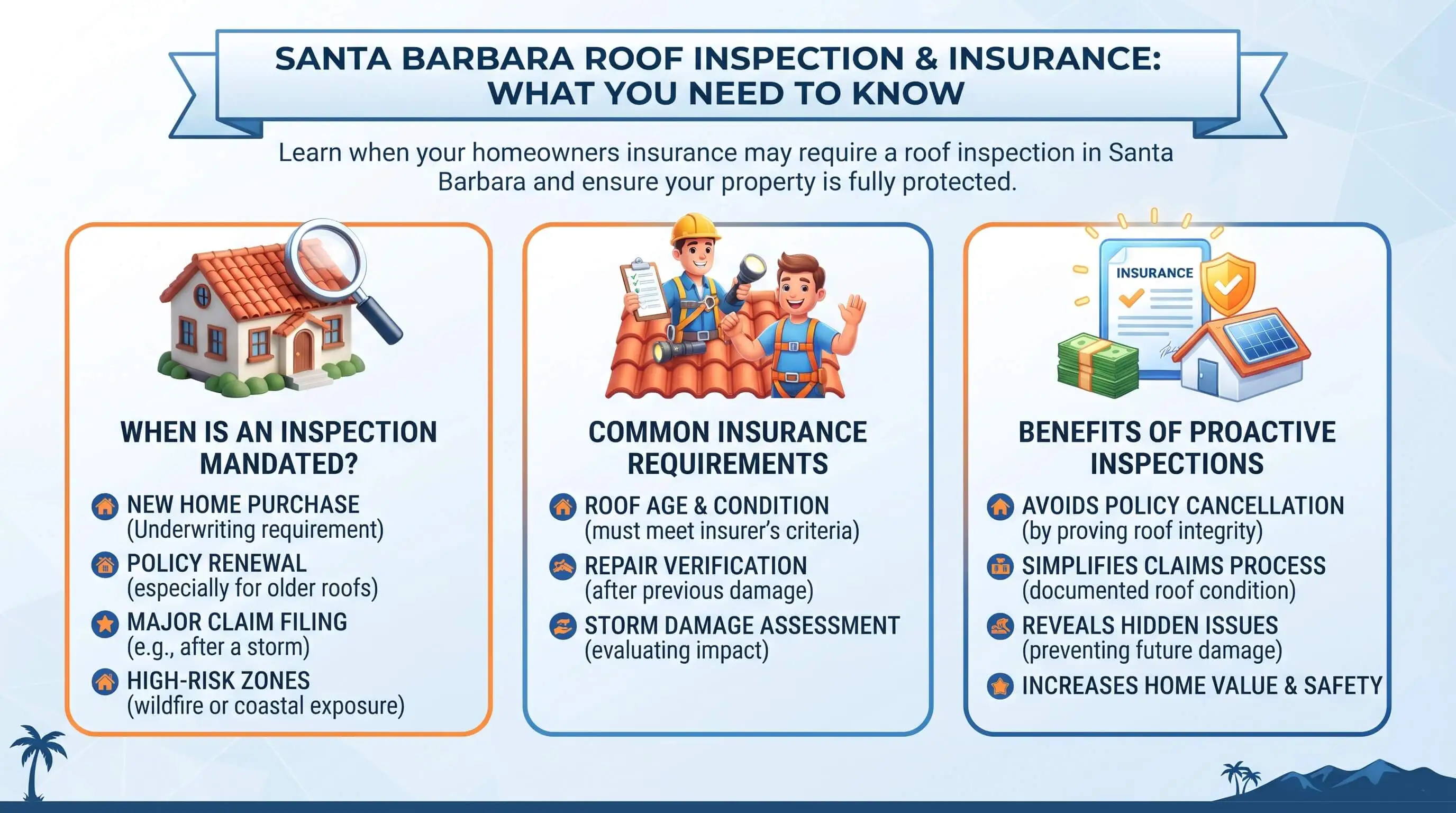
California law doesn't require a roof inspection for homeowners insurance, but individual insurers often ask for one.
Underwriters weigh roof age and material heavily, and some carriers draw the line near 25 years.
An aerial image can trigger a non-renewal, and your insurer has to give you at least 75 days' notice.
Insurers watch for the same Santa Barbara problems inspectors find, from cracked tile to clogged valleys.
A dated, photo-documented report from a licensed roofer is the best preparation you can keep on file.
The Short Answer for Santa Barbara Homeowners
Your roof matters to an insurer because it's the part of the house most likely to turn a winter storm or a stray ember into a claim. So the questions can come at any point in a policy. Some carriers ask before they'll write coverage at all. Others wait until renewal, once the roof passes an age they've set internally, and a growing number start with an aerial image the homeowner never saw.
You don't have to wait for that letter. An inspection report gives you a dated record of your roof's observed condition, with photographs, and you can send it to your agent before anyone else decides what shape the roof is in. It can also help you prioritize roof replacement Santa Barbara services when significant damage or deterioration is documented.
When Insurers May Ask for a Roof Inspection
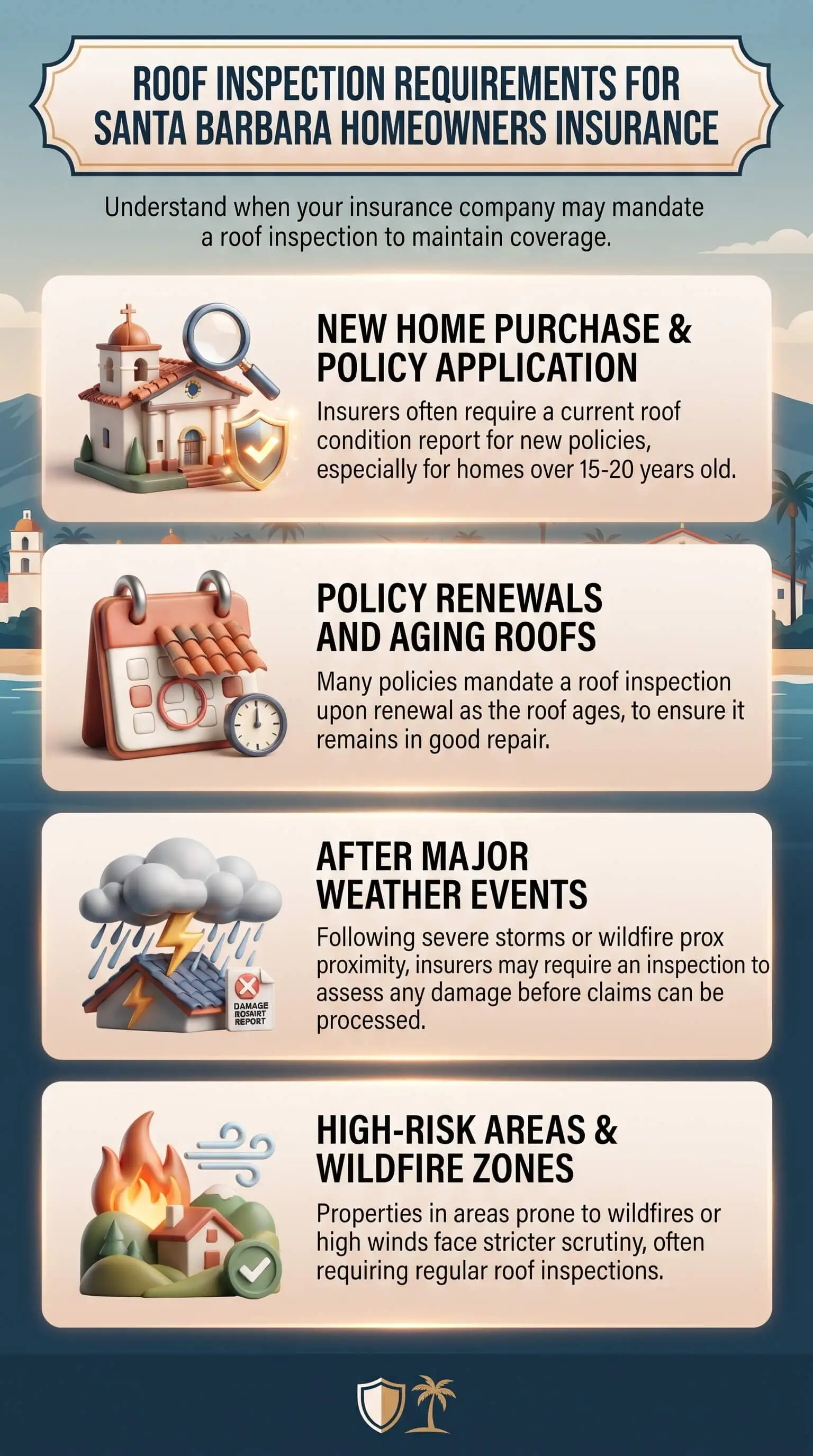
Six situations account for most requests. Find yours below and you'll know what to have ready.
Applying for a new policy. The insurer will likely ask about your roof's age, material, and condition. Keep the install date, permits, and any recent inspection report close at hand.
Renewing with an older roof. Expect a request for proof that the roof still has useful life. A dated photo report from a licensed roofer answers it directly.
A flagged aerial or satellite review. The insurer wants a response to one specific finding. Current photographs show whether someone fixed the issue or the image simply got it wrong.
Switching carriers or moving to the FAIR Plan. Your roof details shape both eligibility and the type of coverage you're offered. Replacement records and inspection findings make the strongest case here.
Filing a claim. The adjuster will want to know what the damage is and when it happened. Before-and-after photos and repair invoices help you show it.
Buying or selling a home. The new policy and the escrow both lean on the roof's condition, so one inspection report can serve the buyer, the seller, and their agents.
How Roof Age and Material Affect Coverage in California
Roof age is the easiest thing for an underwriter to check, which is why it carries so much weight. In May 2026, Insurance Business reported on a review of underwriting filings from California's 20 largest home insurers. Roof age, material, design, and upkeep all came up as core factors.
Each carrier draws its own lines. Mercury and Wawanesa generally won't insure roofs older than 25 years, although tile and slate can be exceptions. Farmers' guidelines indicate that asphalt roofs past 15 years may qualify only for actual cash value coverage, which pays the roof's depreciated value rather than the cost to replace it.
The California FAIR Plan uses a similar rule. On a home more than 25 years old, the FAIR Plan won't offer full replacement-cost coverage unless someone replaced the roof within that period.
Here's how that usually plays out by roof type:
Asphalt shingle: gets the closest look once it reaches 15 to 25 years. Your coverage type can change before your eligibility does.
Clay and concrete tile: often gets more leeway on age. The tiles can last for decades, though the underlayment and flashing underneath wear out much sooner.
Flat and low-slope: drainage is the main concern. Some insurers require a minimum slope or working drains.
Wood shake or shingle: faces the strictest limits of any material, especially in wildfire areas. Many major insurers won't cover it.
Aerial Images, Drones, and Your Renewal Notice
Insurers now review many roofs from above before anyone visits. A satellite, aircraft, or drone photo can catch missing tiles or debris in a valley. It can also be months out of date.
The California Department of Insurance (CDI) told state lawmakers that some insurers judged roof condition from aerial images more than 18 months old (CalMatters Digital Democracy). Lawmakers tried to set limits in 2026 with AB 1559, which would have required notice before insurers collected these images and capped how old they could be. The bill passed the Assembly, then stalled in the Senate, and it never became law.
The protection you have today is time. California Insurance Code Section 678 requires your insurer to give a specific reason at least 75 days before it non-renews your policy. Use those weeks well, because a dated, photo-documented inspection is the strongest reply you can send.
Santa Barbara Roof Conditions Insurers Look For
Between marine moisture, strong sun, sundowner winds, and a long fire season, Santa Barbara puts a roof through a lot. Insurers tend to flag the same conditions a professional inspector documents:
Cracked, slipped, or broken clay tiles, especially on older Spanish-style homes
Flashing that's pulling away from walls, chimneys, skylights, and vents
Dried-out sealant around roof penetrations
Leaves and debris packed into valleys, gutters, and drains
Standing water on flat and low-slope sections
Stains or soft spots left by earlier leaks
Old repairs that are starting to give out
Fire rating carries extra weight here. California's Safer from Wildfires framework lists a Class A fire-rated roof as one of the steps insurers must reward with a discount. Most asphalt shingle, tile, and metal roofs already qualify, but wood shake does not.
Where HVAC Equipment Meets the Roof
Every vent, flue, condenser stand, and duct run through your roof creates a seam that water will eventually find. Inspectors check these points early. When an installer skips resealing the flashing after new HVAC work, that penetration is often where the next leak begins.
Has HVAC work been done in the last few years? Ask your inspector to look closely at those spots, and read more about where roof leaks commonly start on Santa Barbara homes.
How to Prepare for an Insurance Roof Inspection
A little preparation turns the inspection into a record that works for you.
Find the roof's install date, permits, and any warranty paperwork.
Gather invoices and photos from past repairs.
Clear gutters, valleys, and drains so the inspector can see the roof's real condition.
Fix the small problems you already know about, such as a slipped tile or a cracked vent boot.
Hire a licensed roofing contractor, and check the license on the CSLB site first.
Ask for a written report with photographs, since a verbal "looks fine" won't carry much weight with an insurer.
Send the report to your agent a month or two before renewal, not after a notice arrives.
What a Professional Roof Inspection Report Gives You
A photo-documented roof inspection Santa Barbara homeowners can hand to an insurer tells far more than a quick look from the driveway. It records what the inspector checked and what they found, with a date attached.
A good report usually includes:
Photographs of each inspected area and any visible concerns
A plain-language summary of the roof's overall condition
Any damage, deterioration, or drainage problems
Which repairs need attention now and which can wait
Items to monitor over time
Most residential inspections take 60 to 90 minutes on site. The written report typically arrives within two to three business days, and if you have a renewal date or another reporting deadline, mention it when you schedule.
An inspection and an estimate do different jobs. The inspection documents your roof's condition, and the estimated prices for specific work. For insurance, start with the inspection.
"Most of the insurance inspections we do around Santa Barbara are for roofs that are in decent shape but have never been documented. We'll get up on a tile roof that's solid overall and find the flashing around a chimney or an HVAC vent starting to lift. That's exactly the kind of detail an aerial photo picks up. When a homeowner sends their agent a dated report with photos before renewal, the question's already answered before anyone asks it. In our experience, that carries more weight than the roof's age on its own."
7 Essential Resources
Keep these sources handy before your next renewal.
Roof (Wikipedia): a plain rundown of roof parts and materials, and how they work together.
CDI: Safer from Wildfires: California's 10 wildfire mitigation steps, starting with a Class A fire-rated roof.
CDI: Insurers Currently Offering Discounts: which carriers apply wildfire mitigation discounts, and how to ask for yours.
California FAIR Plan Association: coverage terms and discounts from the state's insurer of last resort.
CSLB License Check: confirm a roofer holds a valid license before you hand their report to an insurer.
United Policyholders: Aerial Photos and Non-Renewals: practical guidance for answering a non-renewal notice that cites an aerial image.
Insurance Business: California Insurers Tighten Roof Coverage Rules: what the state's biggest carriers say about roofs in their underwriting filings.
3 Statistics
90%: the share of California's 2024 homeowners insurance premiums written by the 20 carriers whose underwriting filings a 2026 review examined. That review found roof age, material, and condition still drive coverage decisions, and that some carriers generally stop at 25 years (Insurance Business).
18 months: the California Department of Insurance testified that some insurers judged roof condition from aerial images older than that (CalMatters Digital Democracy).
$252: the 2026 national average for a professional roof inspection, with most homeowners paying between $125 and $383 (Fixr). That's a national figure. Local pricing depends on your roof's size, material, and access, plus what the report needs to cover.
Final Thoughts and Opinion
In my experience, homeowners who get blindsided by a renewal notice usually have ordinary roofs and no paperwork to back them up. Insurers decide from age charts and photos taken from the sky. Without a record of your own, theirs becomes the only version of your roof that counts.
So look at your roof the way your insurer does. Know its age and its material, and schedule the inspection on your timeline instead of theirs. A few months before renewal is ideal, because you still have room to fix something small or send a report.
Keep some perspective, too. Not every finding means the roof needs to be replaced. Often the fix is a handful of tiles or a resealed vent, and handling those early is one of the most practical ways of protecting your home's value. Your coverage benefits right along with it.
Frequently Asked Questions
Is a roof inspection legally required for homeowners insurance in California?
No. California has no statewide law requiring a roof inspection to buy or renew homeowners insurance. Each insurer writes its own underwriting rules, though, and many ask for an inspection, photos, or roof details when a roof is older, a policy is new, or an aerial image raises a question. Your agent can tell you what your carrier expects.
Can my insurer non-renew my policy because of my roof's age?
Yes. Roof age ranks among the most common underwriting factors in California, and some carriers generally decline roofs older than 25 years. Insurance Code Section 678 requires your insurer to give at least 75 days' notice with a specific reason. That gives you time to schedule an inspection, make repairs, or shop for other coverage.
How old is too old for a roof in California insurance underwriting?
The answer depends on the insurer and the material. Some carriers set limits around 25 years and give tile and slate more room. Others may move asphalt roofs to actual cash value coverage after about 15 years. The FAIR Plan limits replacement-cost coverage on homes over 25 years old unless someone has replaced the roof in that time.
Will my insurer accept an inspection report from a roofing contractor?
Many insurers and agents will review a report from a licensed roofing contractor, especially one with dated photos and written findings. The carrier makes the final call, so ask your agent before you book. And check your roofer's license with the Contractors State License Board before you rely on the report.
Can insurers use drone or satellite photos to evaluate my roof?
Yes. Many insurers review roofs using satellite, aircraft, or drone images, and those photos can lead to questions at renewal. An image can be old or misread. If a notice cites one, ask your insurer for the image and the specific finding, then reply with current photos and a professional inspection report.
How long does a roof inspection in Santa Barbara take, and when do I get the report?
Most residential roof inspections in Santa Barbara take about 60 to 90 minutes on site, and larger or more complex roofs take longer. You'll typically receive the written report with photos within two to three business days. If you're working against an insurance deadline, ask about faster turnaround when you schedule.
Does a Class A fire-rated roof lower my premium?
It can. California's Safer from Wildfires regulation requires insurers that price for wildfire risk to offer discounts for qualifying mitigation, and a Class A fire-rated roof is on that list. Most asphalt shingle, tile, and metal roofs qualify. Ask your insurer how the discount applies to your policy.
Schedule a Roof Inspection Before Your Renewal
Your insurer will form an opinion about your roof either way. Make sure your own record is on file first.
Quality Roofing has served Santa Barbara County since 1996 and has worked on more than 10,000 roofs. Each inspection comes with photographs and clear written findings, plus next steps you can pass straight to your agent. Call (805) 965-2416 or request a roof inspection to get your roof documented before renewal. Quality Roofing is licensed, bonded, and insured (CSLB #504492).


