Leaking roof in Santa Barbara? The stain on your ceiling is almost never sitting under the spot where the water got in. It shows up the morning after the first big storm, and most people look straight up and figure the hole is right there.
Water that gets past a roof travels first. It slides along the underlayment, follows a rafter, and drips wherever it runs out of room, sometimes eight or ten feet away. So somebody caulks the spot above the stain, the next storm rolls in, and the stain comes right back.
Santa Barbara makes this harder. A house here can go most of the year without a real soaking. Sealant dries out in the sun and leaves collect in the valleys, and nobody notices because nothing is getting wet. Then an atmospheric river parks over the South Coast and tests every seam on the roof in a single weekend.
We've traced leaks on tile, shingle, and flat roofs from Carpinteria to Goleta for a long time, and they tend to start in the same handful of places. Each one leaves its own clues inside the house. Below, we cover each spot and the signs inside your house that point to it. Finding where the water actually gets in is the whole job, and it's the first step in any roof repair Santa Barbara homeowners can count on to last past the next storm.
TL;DR Quick Answers
past the next storm. Roof Repair Santa Barbara
Good roof repair in Santa Barbara starts with finding where the water actually gets in. The stain inside is rarely right under the leak, so patching that spot is the most common reason leaks come back.
Where Santa Barbara leaks usually start:
Flashing at stucco walls and chimneys
Worn underlayment under clay tile, even when no tiles are broken
Flat roofs, parapet walls, and clogged scuppers
Valleys full of oak, sycamore, or eucalyptus debris
Sun-cracked pipe boots, vents, and rooftop equipment curbs
Skylight curb flashing
Overflowing gutters and missing drip edge
Why timing matters here:
Long dry months hide failing flashing and sealant until one winter storm exposes everything at once.
Late summer or early fall is the best time to inspect, before the rain finds the problem for you.
Repair or replace?
If the roof is fairly young and the damage stays in one area, a focused repair is usually the right call.
Leaks that keep returning in different spots often point to worn underlayment or an aging roof system.
Before you hire, check the roofer's license with the CSLB, ask how they'll trace the source, and dry any wet materials within 24 to 48 hours to stop mold.
Top Takeaways
The stain is rarely right under the leak.
Water runs along the underlayment and framing before it drips, so patching the spot above the stain is the most common reason leaks come back.
Seven spots cause most Santa Barbara roof leaks.
Flashing at walls and chimneys, tile underlayment, flat roofs and parapets, valleys, pipe boots and rooftop equipment, skylights, and gutters or drip edges.
Each leaves a different clue inside the house.
Our weather hides problems, then exposes them all at once.
Long dry stretches let flashing and pipe boots fail quietly.
County rainfall has swung from 51% to more than 200% of normal in recent years.
A tile roof can look perfect and still leak.
The underlayment under the tile does the waterproofing, and it wears out well before the tile does. Wide or shifting stains on a tile-roofed home often point here.
Move fast once water gets in.
The EPA advises drying wet materials within 24 to 48 hours to prevent mold.
Check the attic and ductwork too, since mold can hide there after a roof leak.
Why Do Santa Barbara Roofs Leak Differently?
Our roofs don't get steady rain all year, and that changes where and when they leak.
Dry months, then a downpour. Small problems have months to grow while the roof stays dry. When winter storms finally arrive, especially atmospheric rivers, a season's worth of water can hit the roof in a few days.
Sundowner winds. These gusts come down off the Santa Ynez Mountains hard enough to lift tile edges and loose flashing. The gap doesn't leak until the rain shows up.
Salt air near the coast. Damp, salty air from the marine layer wears on metal flashing, fasteners, and valley metal faster than it would a few miles inland.
Strong sun. UV dries and cracks rubber pipe boots and sealants years before the rest of the roof is worn out.
The way we build. Spanish Revival homes with clay tile, flat-roof Mediterranean designs with parapet walls, and low-slope mid-century houses each have their own weak spots.
The 7 Most Common Places Roof Leaks Start
1. Flashing at walls, chimneys, and roof-to-wall transitions
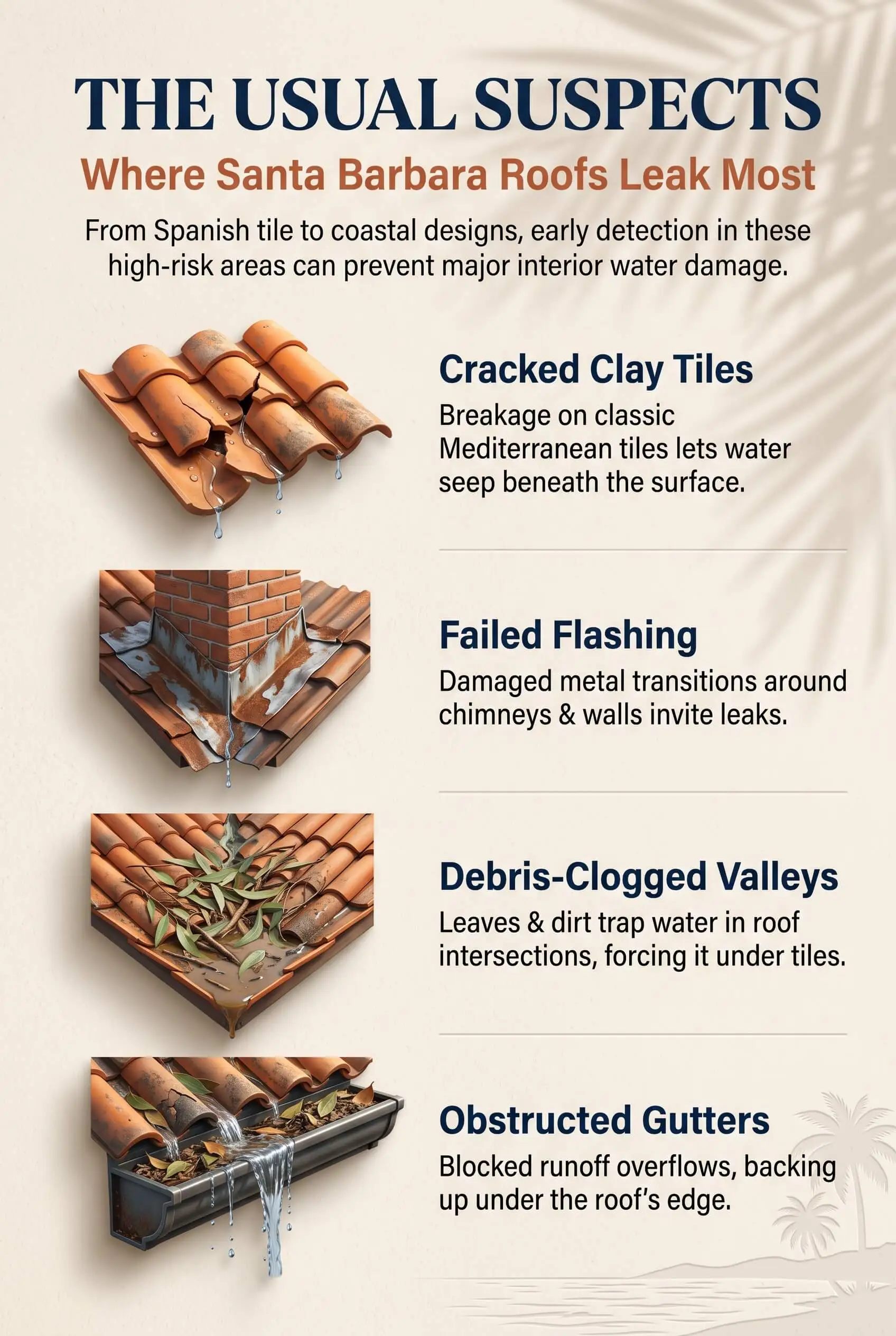
This is the leak we find most often on Santa Barbara homes. Where a roof meets a stucco wall or chimney, the step flashing and counterflashing get buried in plaster and slowly pull loose as the house moves. Sealant used in place of real flashing usually gives out after a few hot summers.
What you'll see inside: Stains along the top of an exterior wall, or around the fireplace chimney, often after wind-driven rain.
2. Underlayment beneath clay tile
This one surprises people. Clay tile can last for generations, but the underlayment underneath is what actually keeps water out, and it wears out much sooner. A tile roof can look perfect from the street while that layer has gone brittle and torn.
What you'll see inside: Stains that spread across a wide area, or show up in a different spot every storm, on a tile roof with no broken tiles in sight.
3. Flat roofs, parapet walls, and scuppers
Flat and low-slope roofs depend on water draining off fast. When a scupper clogs or a section of roof sags, water sits there. Parapet caps crack too, and water gets into the wall itself long before it reaches the ceiling.
What you'll see inside: Stains on interior walls right below a parapet, or a ceiling stain that keeps growing for days after the rain stops.
4. Roof valleys
A valley takes water from two roof planes at once. Add leaves and seed pods from the oaks, sycamores, and eucalyptus around town, and the valley dams up. Water backs up and pushes sideways under the tile or shingle.
What you'll see inside: A stain in the middle of a room that lines up with a valley overhead, usually worst during heavy, fast rain.
5. Pipe boots, vents, and rooftop equipment
Every pipe, vent, and rooftop unit is a hole in the roof that depends on a seal. Rubber pipe boots crack in our sun. Rooftop HVAC curbs and solar mounts leak if nobody flashed them into the roof correctly.
What you'll see inside: A small, round stain near a bathroom fan, a plumbing wall, or right below rooftop equipment.
6. Skylights
Skylights rarely leak through the glass. They leak at the curb flashing around the frame. They also collect condensation, which gets blamed on the roof all the time. Drips on a cool, dry morning usually mean condensation, while drips that only come with storms point to the flashing.
What you'll see inside: Water stains or peeling paint in the skylight well, usually on the uphill side.
7. Gutters, drip edge, and fascia
Some "roof leaks" start at the edge. A clogged gutter overflows back toward the house, and a missing or bent drip edge lets water wick behind the fascia and into the soffit or wall.
What you'll see inside: Stains near the ceiling line along an outside wall, or soft, rotting fascia boards outside.
Where the Stain Shows vs. Where the Leak Starts
Ceiling near an exterior wall: Check wall or step flashing and gutter overflow first.
Around a chimney breast: Check the chimney counterflashing.
Center of a room under a valley: Look for a clogged or worn valley.
Near a bathroom fan or plumbing wall: Look for a cracked pipe boot or vent flashing.
Around a skylight well: Check the curb flashing, or rule out condensation.
Interior wall below a flat roof: Check the parapet cap, scuppers, and any ponding water.
Wide or shifting stains on a tile-roofed home: Suspect worn underlayment.
What Your HVAC System Can Tell You About a Roof Leak
Your attic often shows a leak before your ceiling does, and your ductwork lives up there with it. Wet, matted insulation, water marks on duct wrap, or a musty smell from the vents after a storm can all mean water is getting in overhead.
Rooftop units and condensate lines also pass through the roof. If you spot a stain near ductwork or an air handler, have it checked soon. The EPA lists the inside of ductwork as one of the places mold hides after a roof leak, and that air reaches every room in the house. If the system itself also needs attention, professional HVAC installation can help ensure rooftop equipment, drainage, and duct connections are set up correctly to reduce the risk of future moisture problems.
When Should You Call a Roofer?
A few checks are safe to do from the ground and the attic. Look for daylight through the roof deck, wet insulation, or dark streaks on the rafters, and use binoculars to scan for slipped tiles or loose flashing. Leave the roof itself to a pro. Wet tile and a steep pitch are no place for a ladder.
Call right away if water is dripping, the drywall is sagging, or water is anywhere near a light fixture or outlet. A small stain that hasn't grown can usually wait a few days for an inspection. Just don't let it ride into the next storm.

"The first big storm of the winter brings the same calls every year. Somebody's got a stain, somebody already caulked the spot right above it, and it's leaking again. We get up there and the water's coming eight or ten feet away. It might be a wall flashing or a valley packed with oak leaves. Sometimes it's tile underlayment that quit years ago. That stuff failed back in August, when there was no rain to show it. If you want one piece of advice from us, have your roof looked at in late summer or early fall. It's a lot easier to fix a problem before the rain finds it for you."
7 Essential Resources
When a leak shows up, or the rainy season is a few weeks out, these are the places we send homeowners. Some help you understand what's going on with your roof. Others help you check the people you hire or protect the rest of the house while the repair gets done.
1. Check a Roofer's License Before Anyone Climbs a Ladder
Nearly any paid roofing job in California calls for a state-licensed contractor. The Contractors State License Board lets you look up a license by number, business name, or person. You'll see its status, bond, workers' comp, and any complaint history. It takes about two minutes, and it should happen before you sign anything.
CSLB: Check a Contractor License
2. See How Much Rain Your Neighborhood Actually Got
The county's Flood Control District runs rain gauges from Carpinteria up to the Santa Ynez Valley. Its real-time and historical numbers help you tie a new stain to a specific storm. They also show why a house on the South Coast can get far more rain than one a few miles inland.
Santa Barbara County Public Works Hydrology Section
3. Watch the Storm Before It Arrives
The National Weather Service office in Oxnard covers Santa Barbara County and puts out the watches, warnings, and atmospheric river forecasts for our area. Check it a few days ahead and you'll have time to clear gutters and valleys, or get a suspect spot looked at before the heavy rain.
National Weather Service Los Angeles/Oxnard
4. Learn What a Good Roofing Contractor Looks Like
The National Roofing Contractors Association has plain homeowner guidance on picking a contractor, warranties, maintenance, and weather damage. It doesn't push any brand, so it's a good way to figure out what to ask before you hire.
5. Understand What Keeps a Tile Roof Dry
If you own a clay or concrete tile roof, the Tile Roofing Industry Alliance covers the part nobody sees, the underlayment. Its technical director says there's no one lifespan for it, since it depends on the product and how it went down. That's exactly why a tile roof that looks fine can still leak.
Tile Roofing Industry Alliance: Underlayment
6. Keep a Leak From Turning Into Mold
The EPA's guide to mold and moisture walks you through what to do after water gets inside. It points to roof materials above ceilings and the inside of ductwork as common hiding spots after a leak. It also warns against running an HVAC system you think might be contaminated.
EPA: A Brief Guide to Mold, Moisture and Your Home
7. Know When Roof Work Needs a Permit
The City of Santa Barbara's Building and Safety Division explains when you need a permit. For one- and two-family homes, it also issues instant online permits for like-for-like reroofing. If a repair grows into a reroof, this is where the paperwork starts.
City of Santa Barbara Building Permit Forms and Applications
3 Statistics
Santa Barbara's Rain Can Swing From Drought to Records in a Single Year
Rain doesn't come to Santa Barbara County at a steady pace. It shows up in bursts, which is a big part of why leaks catch people off guard.
The county got 203% of its normal rainfall in the 2023 water year and 143% in 2024, with atmospheric river storms behind both.
The 2024–25 water year then came in at only 51% of normal.
By late November 2025, the city of Santa Barbara was off to its wettest water-year start in 127 years of records, and parts of the South Coast had already picked up 7 to 11 inches that month.
For your roof, a dry year lets flashing and underlayment fail without anyone noticing. Then one big storm finds all of it at once.
Source: Santa Maria Sun, reporting Santa Barbara County Flood Control District data (Nov. 27, 2025)
Water Damage Ranks Among the Most Common and Costly Home Insurance Claims
Insurance numbers show how often water gets into homes and what it costs when it does.
Water damage and freezing made up 22.6% of homeowners insurance claims in 2023, second only to wind and hail.
From 2019 to 2023, the average claim in that category came to $15,400.
Roughly one in 60 insured homes files a water damage or freezing claim each year, and the category includes mold when a policy covers it.
On the South Coast, freezing almost never comes into play, so the water damage half of that category is the part to watch. Catch a leak early and you're paying for a repair. Let it go and you may end up filing a claim.
Source: Insurance Information Institute, Facts + Statistics: Homeowners and Renters Insurance
You Have About 24 to 48 Hours Before Mold Becomes the Bigger Problem
The EPA wants wet building materials dried out fast.
It advises drying water-damaged areas and items within 24 to 48 hours to prevent mold growth, and says that in most cases mold won't grow if you do.
It names roof materials above ceilings and the inside of ductwork among the places mold hides after a roof leak.
So when a stain appears, don't wait for the next storm to see if it happens again. Find the source and get the wet materials dried out.
Source: U.S. EPA, A Brief Guide to Mold, Moisture and Your Home
Final Thoughts and Opinion
Here's our honest take. In Santa Barbara, the best time to find a roof leak is before the rain finds it for you.
Most of the leaks we trace didn't start in the storm that exposed them. A flashing seam cracked in August while a pipe boot split in the summer sun. By October, oak leaves had packed a valley. None of it showed until the first real rain brought every problem to light on the same night.
We gently push back on two habits we see all the time. The first is patching the stain instead of tracing the source. Caulk the spot that looks wrong and there's a good chance we'll be back up there next winter, because the water usually comes in several feet from where it shows inside. The second is waiting to "see if it happens again." It will, and every storm in between soaks a little more insulation and gives mold more time behind the drywall.
In our experience, the homeowners who spend the least on their roofs over the years aren't always the ones with the newest roof. They get an inspection in late summer or early fall and keep the valleys and gutters clear. Small problems get fixed while they're still small. And if your roof is fairly young and the damage stays in one area, a focused repair is usually the smart call over anything bigger.
The way Santa Barbara homes are built makes this matter even more. A clay tile roof can look perfect for decades while the underlayment under it wears out. A flat roof behind parapet walls can hold water a long time before you ever see a stain. You can't judge either one from the driveway.
If you've already got a stain, use it as a clue. Find where the water really gets in, fix that, and dry everything it touches. If the moisture is close to ductwork or an air handler, trusted HVAC experts can check the system for hidden water damage and make sure everything is dry and working properly. That's how a recurring leak becomes a one-time repair.
Frequently Asked Questions
Q: Why does my roof only leak during heavy rain?
A: Light rain usually runs off before it finds a weak spot. Heavy, wind-driven rain pushes water sideways under tile and flashing and overloads clogged valleys, scuppers, and gutters. That's why a roof can stay dry for months and then leak in the first atmospheric river of the season. When a leak only shows up in big storms, we usually look at flashing, valleys, or drainage before anything else.
Q: Can a clay tile roof leak even if no tiles are broken?
A: Yes. We see it all the time. The tile sheds most of the water, but the underlayment underneath is the real waterproof layer, and it ages much faster than the tile. Once it turns brittle or tears, water that slips past the tile reaches the roof deck. The fix usually means lifting the tile, putting down new underlayment, and resetting the original tile.
Q: How do I know if it's a roof leak or condensation?
A: Timing tells you a lot. Water that shows up during or right after rain is most likely a roof leak. Drips on cool, dry mornings, especially around skylights, attic ducts, or cold pipes, often mean condensation. Up in the attic, rusty nail tips and even dampness across the underside of the roof deck usually point to condensation, while a single wet trail points to a leak.
Q: Is a small roof leak an emergency?
A: Not always, but it shouldn't wait for the next storm. Call right away if water is dripping, the ceiling is sagging, or there's water near lights or outlets. A small, dry stain that hasn't grown can usually wait a few days for an inspection. Either way, get wet materials dried within 24 to 48 hours so mold doesn't get a start.
Q: How much does it cost to fix a roof leak in Santa Barbara?
A: That depends on where the water gets in and what it's damaged. A cracked pipe boot or a short run of flashing is a fairly small job. Lifting tile to replace underlayment, fixing a flat roof that ponds, or replacing wet decking costs more. Roof type, pitch, access, and how long the leak has been going all play in. The only way to get a real number is an inspection that finds the actual entry point first.
Get Your Leak Traced Before the Next Storm
If there's a stain on your ceiling, or nobody has looked at your roof since last winter, now's a good time. Have a licensed local roofer find where the water is really getting in before the next storm does it for you. Check their license and ask how they plan to trace the source. If the damage goes beyond a simple repair, roof replacement in Santa Barbara may be the better long-term solution, especially when leaks keep returning or large sections of the roof are already failing. Then get it fixed before the damage gets worse.